
Quick answer: Diagnostic errors are among the most serious and costly problems in healthcare. An estimated 795,000 Americans die or are permanently disabled by diagnostic error each year across all care settings. That total breaks down into roughly 371,000 deaths and 424,000 permanent disabilities annually. Because most diagnoses depend on laboratory results, the quality of clinical laboratory testing, especially the collection and handling of specimens before they are ever analyzed, plays a central role in whether those errors happen or are prevented. Reducing them is both a patient-safety imperative and an economic one, and the laboratory is one of the most effective places to intervene.
Diagnostic errors are missed, wrong, or delayed diagnoses. They differ from treatment errors in that the failure occurs in figuring out what is wrong, before treatment even begins. Their cost is measured not only in dollars but in lives, disability, eroded trust, and wasted resources. This article explains what diagnostic errors actually cost, the specific role laboratory testing plays, why the true burden stays largely hidden, and what can be done to reduce it. Five frequently asked questions and structured data are included at the end to make the key facts easy to find and cite.
What Diagnostic Errors Actually Cost

The human cost is staggering and, until recently, poorly quantified. In 2023, a research team from the Johns Hopkins Armstrong Institute Center for Diagnostic Excellence and Harvard’s Risk Management Foundation produced what is believed to be the first rigorous national estimate of permanent disability and death from diagnostic error across all clinical settings. The finding was that an estimated 795,000 Americans die or are permanently disabled by diagnostic error each year, confirming the pressing nature of the public health problem. Lead investigator David Newman-Toker and colleagues published the analysis in BMJ Quality & Safety, and researchers have described the scale of harm as a public health emergency.
What makes the problem more tractable than the headline number suggests is its concentration. Just 15 diseases account for 50.7 percent of total serious harms, and the top 5, stroke, sepsis, pneumonia, venous thromboembolism, and lung cancer, account for 38.7 percent. Stroke alone is the single largest contributor. The error rates for individual conditions vary enormously: some dangerous diseases are missed only rarely, while spinal abscess, an infection of the central nervous system, is misdiagnosed more than 60 percent of the time, though its relatively low incidence means it accounts for a smaller share of total harm. This concentration matters because it means targeted intervention on a handful of conditions could prevent a large fraction of the harm.
The financial cost compounds the human toll. Diagnostic errors drive unnecessary follow-up testing, repeat procedures, extended hospital stays, and litigation. Diagnostic errors have become the most prevalent type of malpractice claim in the United States, a pattern that reflects both their frequency and their severity. Beyond malpractice, every erroneous or delayed diagnosis generates downstream spending on care that would not have been needed had the diagnosis been correct the first time.
The Laboratory’s Central Role

Because most diagnoses begin with or are confirmed by laboratory testing, the reliability of the clinical laboratory sits at the heart of diagnostic accuracy. When a laboratory result is wrong, delayed, or misinterpreted, the diagnostic process built on top of it inherits the flaw.
The critical and often surprising fact is where laboratory errors originate. Decades of research have shown that the analytical phase, the actual measurement performed by instruments, is the least error-prone stage. The majority of diagnostic laboratory errors are either pre-analytical, at 46 to 68 percent, or post-analytical, at 18 to 47 percent, while only 7 to 13 percent of errors actually occur during the analytical phase. Some analyses place the pre-analytical share even higher; preanalytical errors contribute to around 60 to 70 percent of laboratory errors, owing to the many activities that take place outside the laboratory and the manual handling of the specimen during this phase.
This means the greatest source of laboratory-related diagnostic error lies in the pre-analytical phase: the ordering, collection, labeling, transport, and handling of specimens before analysis. A mislabeled or contaminated specimen, a hemolyzed sample that falsely elevates potassium, or a delayed transport that degrades an analyte can all send a clinician down the wrong diagnostic path regardless of how accurate the instrument is. The post-analytical phase carries its own risks: in 37 percent of ambulatory diagnostic errors that led to malpractice claims, incorrect interpretation of the laboratory test result caused the error. The post-analytical phase, where results are validated, reported, and interpreted, is where a technically correct measurement can still become a wrong decision.
The good news embedded in this data is that the biggest error sources are also among the most preventable. They are largely process and human-factor failures, not exotic technical ones, which means robust quality management and disciplined specimen handling can address them directly.
Why the True Cost Stays Hidden
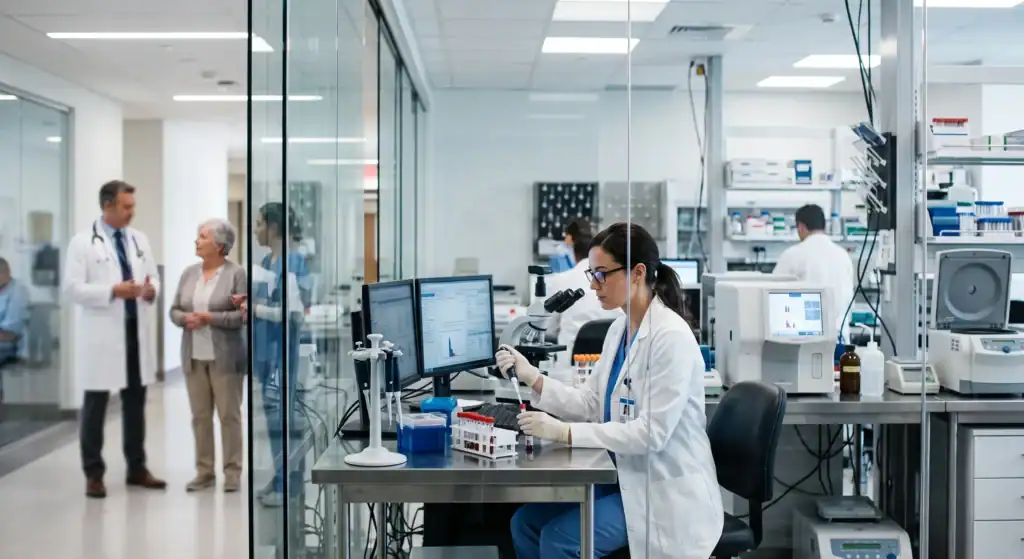
If diagnostic errors cause this much harm, why are they not treated with the same urgency as more visible safety problems like surgical errors or medication mistakes? The answer lies in why the cost is hidden.
The first reason is that many diagnostic errors are never detected. A missed diagnosis often becomes apparent only later, when the patient deteriorates, is seen by a different clinician, or is diagnosed at autopsy. By then the original error may not be recognized as the cause, and it is never counted. Researchers acknowledge that settling on an exact number is difficult precisely because so many cases go undetected, which is why estimates of total annual diagnostic errors range into the tens of millions.
The second reason is diffusion. Unlike a wrong-site surgery, which is a discrete, visible event, a diagnostic error unfolds across time and across multiple clinicians and settings. The specimen collected in a clinic, analyzed in a laboratory, and interpreted by a physician passes through many hands, and when the outcome is bad, no single visible moment captures where it went wrong. The cost is spread thin across the system rather than concentrated in an obvious failure.
The third reason is the laboratory’s own invisibility. Because laboratory professionals work behind the scenes and rarely interact with patients directly, the laboratory’s contribution to both diagnostic success and diagnostic error is easy to overlook. When a diagnosis is correct, the laboratory rarely gets credit; when a specimen problem contributes to an error, the laboratory’s role is often invisible in the aftermath. This invisibility makes it harder to direct attention and resources to the pre-analytical and laboratory processes where much of the preventable error lives.
What Can Be Done to Reduce the Burden

The concentration of harm in a small number of conditions and the concentration of laboratory error in the pre-analytical phase both point to the same conclusion: this problem, while enormous, is more tractable than its scale suggests. Several evidence-based interventions can meaningfully reduce the burden.
Strengthening pre-analytical processes offers the highest laboratory-side leverage. Because the majority of laboratory errors occur before analysis, improvements in specimen collection technique, patient identification, labeling, and transport prevent errors at their most common source. Barcode scanning that verifies patient identity against the order, validated transport systems, and structured specimen-acceptance criteria all attack the pre-analytical phase directly. Phlebotomy training has one of the clearest evidence bases for reducing specimen-related errors.
Improving the post-analytical interface between laboratory and clinician addresses the interpretation errors that drive a large share of malpractice claims. Clear reporting, interpretive comments that flag limitations, critical-value notification systems with verified read-back, and ongoing communication between laboratory professionals and ordering clinicians all reduce the risk that a correct result is misread or acted on incorrectly.
Building a strong quality culture ties it together. The evidence in patient safety science consistently shows that psychological safety, transparent error reporting, and management accountability determine whether formal safety systems actually work. Laboratories that treat errors and near-misses as learning opportunities rather than occasions for blame generate the data needed to fix systemic problems.
Targeting the high-harm conditions concentrates effort where it matters most. Because five diseases account for nearly 40 percent of serious harm, focused diagnostic pathways, decision support, and quality initiatives around stroke, sepsis, pneumonia, venous thromboembolism, and lung cancer could prevent a disproportionate share of harm. Researchers have estimated that cutting harms from just those five conditions by half would prevent enormous numbers of deaths and disabilities.
Finally, emerging technology has a role. Artificial intelligence and decision-support tools that flag anomalies, catch implausible results, and support interpretation can reduce error when deployed responsibly, though they require rigorous validation and human oversight to avoid introducing new problems.
Conclusion
The hidden cost of diagnostic errors is measured in nearly 800,000 Americans killed or permanently disabled each year, in the financial burden of unnecessary care and litigation, and in the erosion of trust that follows when the diagnostic process fails. Much of that cost is preventable, and the laboratory, particularly the pre-analytical processes where the majority of laboratory errors originate, is one of the most powerful places to intervene.
The problem’s scale can feel paralyzing, but its concentration is a reason for hope. A small number of conditions cause much of the harm, and a small number of process failures cause much of the laboratory error. Addressing them through stronger specimen handling, better laboratory-clinician communication, a genuine quality culture, targeted attention to high-harm diseases, and carefully validated technology can save lives and money at the same time. Making the hidden cost of diagnostic errors visible is the first step toward reducing it, and the laboratory profession is central to that effort.
Frequently Asked Questions
How many people are affected by diagnostic errors each year?
In the United States, an estimated 795,000 people die or are permanently disabled by diagnostic errors each year across all care settings, according to a 2023 Johns Hopkins and Harvard study published in BMJ Quality & Safety. That figure breaks down into roughly 371,000 deaths and 424,000 permanent disabilities annually. The total number of diagnostic errors, including those that do not cause serious harm, is estimated to be far higher, on the order of tens of millions per year, because many errors are never detected or counted.
What are the most commonly missed diagnoses?
Fifteen diseases account for about half of all serious harm from diagnostic error, and just five account for nearly 40 percent: stroke, sepsis, pneumonia, venous thromboembolism (blood clots), and lung cancer. Stroke is the single largest contributor. Some conditions have very high individual miss rates, such as spinal abscess, which is misdiagnosed more than 60 percent of the time, but cause less total harm because they are rarer. The concentration of harm in a few conditions means targeted improvements could prevent a large share of it.
How do laboratory errors contribute to diagnostic errors?
Because most diagnoses depend on laboratory results, laboratory errors can directly cause misdiagnosis. Most laboratory errors, roughly 46 to 68 percent and by some estimates 60 to 70 percent, occur in the pre-analytical phase, before the specimen is ever analyzed: mistakes in test ordering, patient identification, specimen collection, labeling, and transport. Only about 7 to 13 percent occur during the actual analysis. Post-analytical errors, including incorrect interpretation of results, are also significant and account for a large share of laboratory-related malpractice claims.
Are diagnostic errors preventable?
Many are. Studies indicate that the large majority of diagnostic errors are preventable, and because laboratory error concentrates in process and human-factor failures rather than technical ones, disciplined specimen handling, patient-identification safeguards, better laboratory-clinician communication, and strong quality management can prevent a substantial portion. Since a small number of conditions cause most of the serious harm, focused diagnostic pathways for those diseases offer additional prevention potential.
What is the financial cost of diagnostic errors?
Diagnostic errors are the most common and among the most costly types of medical malpractice claims in the United States, and they generate large downstream costs through unnecessary testing, repeat procedures, extended hospital stays, and delayed or inappropriate treatment. Within the laboratory, pre-analytical errors alone are estimated to represent between 0.23 and 1.2 percent of total hospital operating costs, which can amount to well over a million dollars per year for a large hospital. The full societal cost, including lost productivity and long-term disability care, is far larger.
Bio-Reach is a non-profit organization dedicated to advancing Laboratory Medicine through advocacy, education, and global collaboration. To learn more or get involved, visit bio-reach.org.