A companion diagnostic is a laboratory test that identifies whether a specific patient is likely to benefit from a specific therapy, most commonly by detecting the genetic mutation, protein biomarker, or other molecular feature that a targeted drug is designed to act on. The global companion diagnostics market is projected to grow from $6.31 billion in 2026 to $11.57 billion by 2031, at a compound annual growth rate of 12.9 percent, driven by the rapid adoption of precision medicine and biomarker-based treatment selection, particularly in oncology. Rather than prescribing a drug and hoping it works, companion diagnostics let physicians know in advance, based on a patient’s own molecular profile, whether a targeted therapy is likely to help, making precision medicine possible in practice rather than only in theory.
For much of medical history, treatment decisions relied on population averages: a drug approved for a disease was prescribed to everyone diagnosed with that disease, and physicians waited to see who responded. Companion diagnostics change this model by identifying, before treatment begins, which patients carry the specific molecular characteristic a targeted therapy addresses. This article explains what companion diagnostics are, how they work, why demand for them is surging, and what their growth means for laboratory medicine.
What a Companion Diagnostic Actually Does

A companion diagnostic is a specific type of laboratory test, most often a molecular or immunohistochemical assay, that is developed and approved alongside a particular drug specifically to determine which patients are eligible to receive it. Companion diagnostics are essential for identifying patient populations most likely to benefit from specific therapies, particularly in oncology, autoimmune diseases, and rare genetic disorders, and their use ensures that patients receive treatments tailored to the molecular characteristics of their own disease rather than a one-size-fits-all approach.
The concept is best illustrated through oncology, where companion diagnostics are most established. A tumor that carries a specific genetic mutation, for example, an EGFR mutation in lung cancer or an HER2 amplification in breast cancer, may respond dramatically to a drug designed to target that exact molecular alteration, while offering little or no benefit to a patient whose tumor lacks it. A companion diagnostic test, performed on a tissue or blood sample before treatment begins, determines which category a given patient falls into, allowing the oncologist to select a therapy matched to that patient’s actual tumor biology rather than to the disease’s general classification.
This distinguishes companion diagnostics from complementary diagnostics, a related but different category of test that provides useful information about a therapy’s likely benefit without being a strict requirement for prescribing it. A true companion diagnostic is typically required, often by regulatory label, before the corresponding drug can be prescribed, making the diagnostic test and the therapy functionally inseparable.
Why Companion Diagnostics Are Growing So Quickly

Several forces are driving the rapid expansion of the companion diagnostics market, and together they explain why this category has become one of the fastest-growing segments within laboratory medicine.
The shift toward precision oncology has made companion testing a prerequisite for modern cancer treatment rather than an optional add-on. Increasing regulatory emphasis on personalized therapeutics, growing pharma-diagnostic partnerships, and expanding approvals of targeted drugs are accelerating market growth globally, and nearly every new targeted cancer therapy now enters the market paired with a specific test that determines patient eligibility. This connects directly to the broader growth in molecular pathology capacity needed to perform this testing at scale.
The pharmaceutical industry has fundamentally integrated diagnostic development into drug development itself. The integration of companion diagnostics into targeted drug development and clinical trial stratification is increasing demand for highly accurate and personalized diagnostic solutions across oncology and rare disease applications, meaning that pharmaceutical companies now routinely partner with diagnostic developers from the earliest stages of a new drug’s clinical trials, rather than developing a companion test as an afterthought once a drug is already approved.
Technological advances are broadening what companion diagnostics can detect and how efficiently they can detect it. Advances in digital pathology, multiplex biomarker analysis, cloud-based bioinformatics, and AI-driven clinical interpretation are improving diagnostic precision, turnaround time, and treatment decision support, allowing a single test to screen for multiple actionable biomarkers simultaneously rather than requiring a separate test for each potential mutation, which both speeds diagnosis and expands the number of patients who can be efficiently matched to an appropriate targeted therapy.
Expansion beyond oncology is broadening the total addressable use of companion diagnostics. While cancer remains the dominant application, companion diagnostics are increasingly used in autoimmune diseases and rare genetic disorders as well, following the same underlying logic: identifying the specific patients whose disease biology matches what a targeted therapy is designed to treat, wherever that logic applies.
Recent Regulatory and Clinical Milestones

The pace of companion diagnostic approvals reflects how deeply integrated this model has become in modern drug development. Recent regulatory milestones continue to expand the range of patients who can be matched to precisely targeted therapy, particularly in oncology, where newly approved drugs increasingly arrive with a specific companion test already validated and required for prescribing.
This pattern extends internationally as well. Regulatory bodies and national insurance systems in multiple regions have expanded reimbursement for comprehensive biomarker profiling, reflecting a global convergence toward requiring molecular characterization before initiating targeted treatment, not only in wealthy healthcare systems but increasingly wherever precision oncology infrastructure is being built out.
What Companion Diagnostics Mean for Precision Medicine
Companion diagnostics represent the clinical mechanism through which the broader promise of personalized health monitoring and precision medicine actually reaches patients. A genomic profile or biomarker panel is only useful for treatment selection if there is a validated, regulator-approved test connecting a specific result to a specific therapeutic decision, and that connective tissue is exactly what a companion diagnostic provides.
This has real consequences for how quickly new precision therapies can reach the patients who need them. Because a targeted drug typically cannot be prescribed without its corresponding companion diagnostic being available and accessible, laboratory testing capacity has become a genuine rate-limiting factor in precision medicine’s practical reach. A patient whose local healthcare system lacks access to the necessary companion diagnostic test may be unable to receive an approved, potentially life-saving targeted therapy, even when that therapy is otherwise available, an access gap that connects directly to the broader challenge of diagnostic access in under-resourced settings.
The Laboratory Workforce Behind Companion Diagnostics

The growth of companion diagnostics places specific demands on the laboratory workforce that performs this testing, demands that go beyond traditional laboratory training.
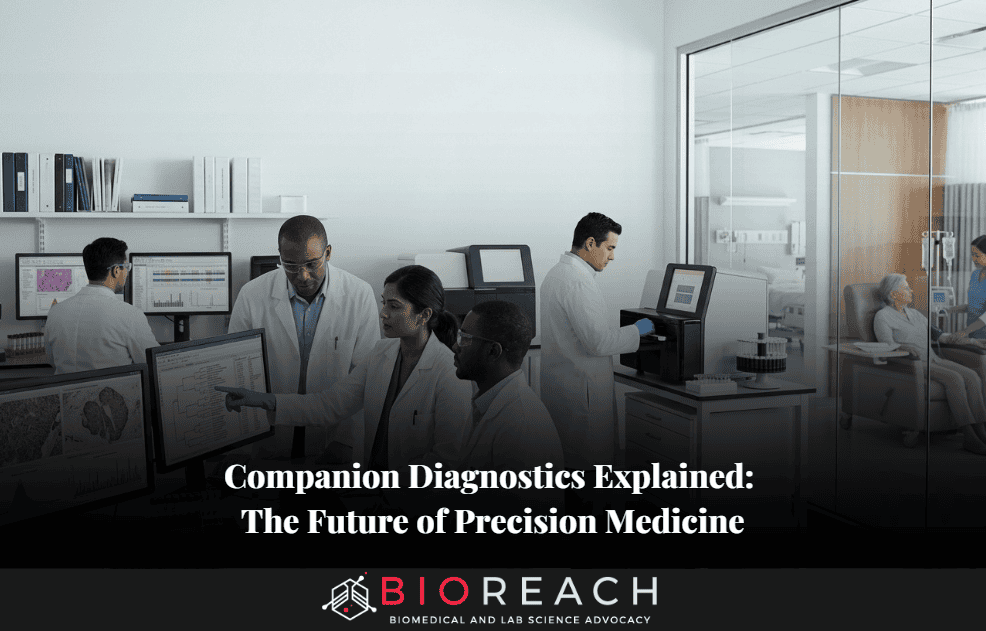
Performing and interpreting companion diagnostic tests requires proficiency with the specific molecular platforms involved, polymerase chain reaction, next-generation sequencing, immunohistochemistry, and in situ hybridization, along with the ability to distinguish a clinically actionable result from background genetic noise. As multiplex panels increasingly screen for many biomarkers simultaneously, laboratory professionals also need the bioinformatics literacy to manage and interpret the resulting data streams, a skill set explored more broadly in the context of the expanding molecular pathology workforce.
Quality management carries especially high stakes in this context. Because a companion diagnostic result directly determines whether a patient receives a specific therapy, often an expensive one with its own risks and side effects, the accuracy of that result matters enormously. The same rigorous pre-analytical, analytical, and post-analytical quality standards that govern laboratory medicine generally apply with particular force to companion diagnostic testing, where an error does not merely produce a wrong number but can direct a patient toward or away from an entire category of treatment.
Conclusion
Companion diagnostics are the mechanism that makes precision medicine’s promise concrete: rather than treating disease categories, clinicians can increasingly treat the specific molecular characteristics of an individual patient’s condition, guided by a validated test developed alongside the therapy itself. The market’s rapid growth, projected to nearly double within five years, reflects how thoroughly this model has become embedded in modern drug development, particularly in oncology.
Realizing companion diagnostics’ full potential depends on laboratory capacity keeping pace with pharmaceutical innovation. Every new targeted therapy that reaches approval creates fresh demand for the specialized molecular testing that determines who can receive it, and ensuring that testing capacity, and the skilled laboratory workforce behind it, is available broadly, not only in the best-resourced healthcare systems, is essential to making precision medicine’s benefits reach the patients who need them.
Frequently Asked Questions
What is a companion diagnostic?
A companion diagnostic is a laboratory test developed and approved alongside a specific drug to determine which patients are eligible to receive it, typically by detecting a genetic mutation, protein biomarker, or other molecular feature that the drug is designed to target. It is most established in oncology, where it identifies which patients’ tumors carry the specific molecular alteration a targeted therapy addresses.
How is a companion diagnostic different from a regular diagnostic test?
A regular diagnostic test typically identifies or characterizes a disease. A companion diagnostic goes further, determining whether a specific therapy is appropriate for a specific patient based on their molecular profile, and it is often required by regulatory label before the corresponding drug can be prescribed. This distinguishes it from a complementary diagnostic, which provides useful but not strictly required information about likely treatment benefit.
Why is the demand for companion diagnostics growing so fast?
Growth is driven by the shift toward precision oncology, where nearly every new targeted cancer therapy now requires a companion test to determine eligibility; the pharmaceutical industry’s integration of diagnostic development into drug development from the earliest clinical trial stages; and technological advances like multiplex biomarker panels and AI-assisted interpretation that make testing faster and more comprehensive.
Are companion diagnostics used outside of cancer treatment? Yes, though oncology remains the largest application. Companion diagnostics are increasingly used in autoimmune diseases and rare genetic disorders, following the same underlying principle: identifying the specific patients whose disease biology matches what a targeted therapy is designed to treat, wherever that molecular matching logic applies.
What skills do laboratories need to perform companion diagnostic testing?
Laboratories need proficiency with molecular testing platforms including PCR, next-generation sequencing, immunohistochemistry, and in situ hybridization, along with the ability to distinguish clinically actionable results from background genetic variation. As multiplex panels expand, bioinformatics literacy to manage and interpret complex data streams is becoming an increasingly essential skill for the laboratory professionals performing this testing.
Bio-Reach is a non-profit organization dedicated to advancing Laboratory Medicine through advocacy, education, and global collaboration. To learn more or get involved, visit bio-reach.org.