
Startups are transforming laboratory medicine by injecting fast-moving innovation, capital, and AI-driven technology into a field that has historically evolved through large, slow-moving institutional channels. US digital health startups pulled in $14.2 billion in 2025, a 35 percent jump from 2024 and the highest total since 2022, and within that broader wave, the medical diagnostics cluster alone secured $2.6 billion in funding, representing 10 percent of total digital health investment. This capital is flowing into AI-assisted pathology, faster and cheaper molecular testing, point-of-care platforms, and diagnostic informatics tools, all aimed at solving the same problems that have long constrained laboratory medicine: workforce shortages, slow turnaround times, and limited access in underserved settings.
The result is a wave of innovation reshaping how diagnostic testing is developed, delivered, and interpreted, working alongside rather than replacing the laboratory professionals and institutions that remain central to the field.
Laboratory medicine has traditionally evolved slowly, shaped by large diagnostic companies, academic medical centers, and multi-year regulatory pathways. That pattern is changing. A new generation of startups, funded at record levels and armed with artificial intelligence, novel biosensors, and cloud-based platforms, is challenging assumptions about how quickly diagnostic innovation can move from concept to clinical use. This article examines where startup-driven innovation is having the greatest impact in laboratory medicine, what is fueling the investment surge, and what this transformation means for the laboratory workforce and the patients who depend on accurate diagnosis.
Where Startup Innovation Is Concentrated
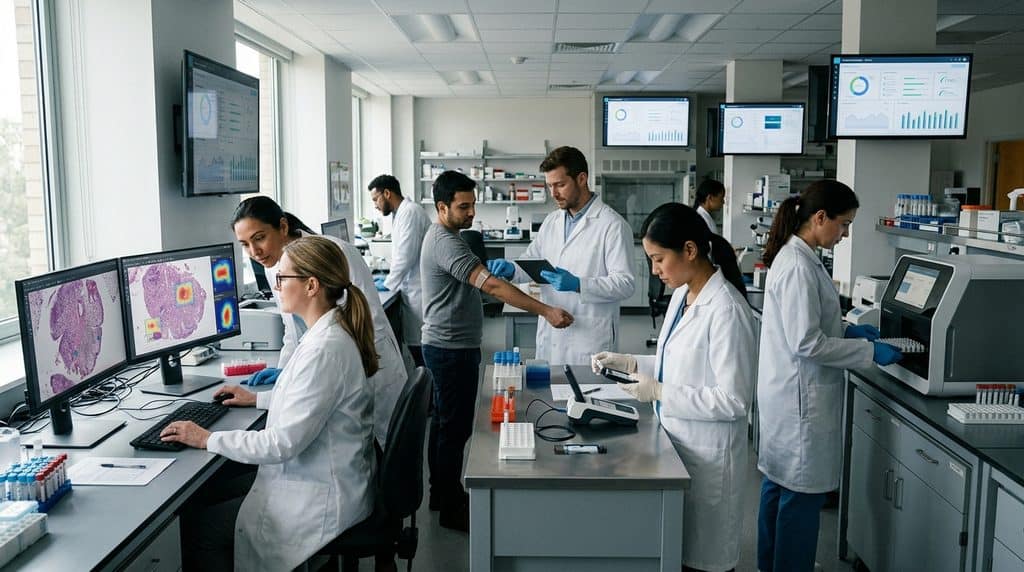
Startup activity in laboratory medicine clusters around several distinct but overlapping areas, each addressing a specific bottleneck in traditional diagnostic delivery.
AI-powered diagnostic interpretation represents one of the most active and well-funded categories. Ireland-based diagnostic AI startup Deciphex raised €31 million in a Series C round to expand its digital pathology platforms to health systems including the NHS, and the company is already diagnosing around 150,000 clinical cases a year while boosting pathologist productivity by up to 40 percent. This kind of AI-assisted workflow support directly addresses the pathologist workload and burnout pressures that have made expert interpretation a genuine bottleneck in cancer diagnosis and other complex pathology.
Point-of-care and portable diagnostic devices are attracting substantial investment as well. The shift toward in-home and patient-centered care is being supported by a wave of new devices, from wearables to portable imaging, that let people monitor and manage their health outside traditional hospital settings, a trend that connects directly to the broader growth of home-based laboratory testing and reflects startups’ particular strength in building consumer-facing, user-friendly diagnostic hardware.
Diagnostic informatics and AI-enabled devices are commanding some of the largest valuations in the sector. The FDA authorized 258 AI and machine-learning-enabled medical devices in 2025 alone, and approximately half of all digital health deals are now AI-enabled, with major acquisitions, including a $585 million purchase of an AI coronary diagnostics company and a $2.3 billion acquisition of an AI-powered imaging software firm, signaling that established diagnostic and device companies view startup-developed AI capability as strategically essential rather than experimental.
Remote and connected monitoring platforms round out the picture, with startups building systems that combine wearable sensors with predictive analytics to flag early physiological changes before they become acute clinical events, extending diagnostic monitoring beyond the walls of any single facility and connecting to the broader shift toward continuous, consumer-driven diagnostics.
Why the Capital Is Flowing Now

Several converging factors explain why laboratory and diagnostic innovation is attracting startup investment at record levels right now, after a notably slower period in the preceding years.
The broader digital health funding recovery has lifted diagnostics along with it. Medical device venture capital, after a two-year trough in 2023 and 2024 when funding volumes dropped sharply, has rebounded to a three-year high, with companies receiving $4.1 billion in venture funding in the second quarter of 2026 alone, putting the sector on pace for its strongest year since 2021. This recovery reflects renewed investor confidence following a period of retrenchment, rather than a permanently accelerating trend, though the current trajectory is strongly positive.
Regulatory validation has become the price of entry rather than an afterthought, which has, somewhat counterintuitively, made diagnostic startups more attractive to serious capital. Within the medical diagnostics cluster, companies achieved 9 regulatory approvals, 3 clinical trials, and 81 peer-reviewed publications in a single year, reflecting that clinical evidence is not optional but the baseline for commercial credibility. This shift toward evidence-first development means diagnostic startups today are increasingly building toward the same rigor expected of established laboratory quality standards, rather than moving fast and skipping validation.
Capital is concentrating rather than spreading thin, which has raised the average quality bar for funded companies. Total venture capital investment increased 20 percent year over year even as the number of funding rounds declined by 47 percent, with the average round size growing substantially larger as later-stage, more clinically validated companies attract the bulk of available capital. This means the startups succeeding in raising significant funding today are, on average, further along in regulatory and clinical validation than the broader pool of earlier-stage companies from a few years ago.
International participation is broadening where diagnostic innovation originates. Fifty-six percent of diagnostic ventures now originate outside the United States, with Europe emerging as a particular powerhouse due to its regulatory rigor, suggesting that startup-driven laboratory innovation is becoming a genuinely global phenomenon rather than one concentrated in a single national ecosystem.
What This Means for Established Laboratory Medicine
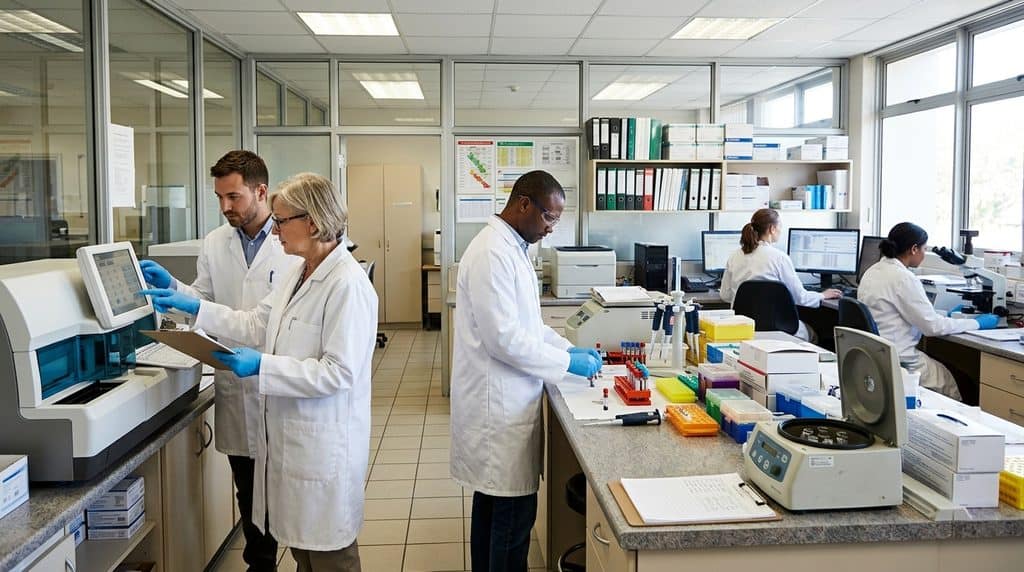
Reading the startup wave as a threat to established laboratory medicine institutions and professionals would be a mistake. The more accurate picture is one of integration: startup innovation is increasingly built to plug into, rather than replace, the existing laboratory infrastructure and workforce.
Corporate venture investment from established diagnostic and device companies illustrates this integration directly. Corporate venture arms including Medtronic Ventures, Johnson & Johnson Development Corporation, and Philips Ventures are actively investing in startups working on AI, robotics, and precision diagnostics, using these investments to secure early stakes in scalable innovations, a pattern that reflects large, established players choosing to acquire innovation through partnership and investment rather than developing everything internally. This is consistent with a broader pattern in which molecular pathology and companion diagnostics development increasingly relies on the kind of pharma-diagnostic and corporate-startup partnerships that accelerate innovation without displacing the underlying laboratory science.
The laboratory workforce remains essential to this transformation rather than displaced by it. AI-assisted pathology platforms, for example, are explicitly designed to boost pathologist productivity rather than eliminate the pathologist’s role, a distinction explored in depth in the discussion of whether automation will replace laboratory professionals. The professionals who validate, interpret, and take responsibility for results remain central even as the tools available to them multiply and improve.
Access implications are a genuine and welcome dimension of this innovation wave. Startups building lower-cost, portable, and AI-supported diagnostic tools have real potential to extend laboratory-quality testing into settings that have historically lacked it, connecting to the broader challenge of expanding diagnostic access in rural and underserved communities and in resource-limited settings globally. Realizing this potential responsibly, rather than creating new access disparities based on who can afford the newest technology, remains an important open question as the sector matures.
The Risks Worth Watching
Rapid startup-driven innovation in laboratory medicine is not without risk, and a fair account of the transformation requires acknowledging them.
Validation gaps remain a persistent concern even as regulatory rigor has generally improved. Not every funded startup has completed the kind of rigorous, population-diverse clinical validation that laboratory medicine’s patient-safety stakes demand, and the pace of innovation can outstrip the pace at which thorough, independent validation can reasonably occur.
Market consolidation risk is real given the capital concentration trend. As funding concentrates around fewer, larger, later-stage companies, promising early-stage innovation with genuine clinical value may struggle to secure the funding needed to reach the market, potentially narrowing rather than broadening the diversity of diagnostic innovation reaching patients.
Integration burden falls on laboratories themselves. Every new diagnostic technology a laboratory adopts, however promising, requires validation, staff training, and integration into existing quality management systems and workflows, a real operational cost that startups developing the technology do not bear directly but that laboratories, already often understaffed, must absorb.
Conclusion
Startups are transforming laboratory medicine by bringing fresh capital, technology, and urgency to a field that has historically moved at institutional speed. From AI-assisted pathology that measurably boosts diagnostic productivity to portable diagnostics extending testing into homes and underserved communities, this wave of innovation is addressing many of laboratory medicine’s most persistent challenges: workforce constraints, turnaround delays, and access gaps.
The transformation works best, and poses the least risk, when startup innovation integrates with rather than bypasses the rigorous quality standards, professional expertise, and patient-safety focus that have always defined laboratory medicine. The most successful startups in this space are increasingly those that recognize this, building tools that make laboratory professionals more capable and diagnostic access more equitable, rather than attempting to route around the laboratory science that makes any diagnostic result trustworthy in the first place.
Frequently Asked Questions
How much funding are laboratory and diagnostic startups currently receiving?
Investment has rebounded strongly after a two-year trough in 2023 and 2024. US digital health startups raised $14.2 billion in 2025, a 35 percent increase from the prior year, with the medical diagnostics cluster specifically securing $2.6 billion. Medical device venture capital reached $4.1 billion in a single quarter in 2026, putting the sector on pace for its strongest year since 2021.
What areas of laboratory medicine are startups focusing on most?
The most active areas include AI-powered diagnostic interpretation, particularly in digital pathology, where AI tools are measurably boosting pathologist productivity; point-of-care and portable diagnostic devices that extend testing beyond traditional facilities; AI-enabled medical devices, with the FDA authorizing 258 such devices in 2025 alone; and remote, connected monitoring platforms.
Are startup diagnostic innovations properly validated before clinical use?
Increasingly, yes, though this varies by company and technology. Clinical evidence has become the baseline for commercial credibility in the sector, with funded diagnostic companies achieving regulatory approvals, completing clinical trials, and publishing peer-reviewed research at meaningful rates. That said, validation gaps remain a legitimate concern, and not every funded startup has completed the population-diverse validation that laboratory medicine’s safety stakes require.
Will startup innovation replace laboratory professionals?
No. The most successful diagnostic startups explicitly design their tools to support and augment laboratory professionals rather than replace them, for example, building AI pathology tools that boost productivity while pathologists retain interpretive and decision-making responsibility. The judgment, quality oversight, and accountability that define laboratory medicine remain functions that require trained professionals, regardless of how sophisticated the supporting technology becomes.
How are established diagnostic companies responding to startup innovation?
Largely through partnership and acquisition rather than competition alone. Corporate venture arms of major medical device and pharmaceutical companies are actively investing in diagnostic startups to secure early access to promising innovations, and several large acquisitions of AI-enabled diagnostic companies in the hundreds of millions to billions of dollars demonstrate that established players view startup-developed technology as strategically valuable to integrate rather than ignore.
Bio-Reach is a non-profit organization dedicated to advancing Laboratory Medicine through advocacy, education, and global collaboration. To learn more or get involved, visit bio-reach.org.