A pathologist reviewing a cancer biopsy has traditionally relied on the same fundamental tool for more than a century: a glass slide, a microscope, and years of trained visual judgment. Today, that slide can be digitized into a high-resolution image, analyzed by an algorithm that has learned from hundreds of thousands of prior cases, and flagged for the specific regions most likely to contain malignancy, all before the pathologist looks at it. This is not a distant future. Artificial intelligence is already embedded in clinical laboratory workflows, and its role is expanding rapidly across pathology, clinical chemistry, microbiology, and molecular diagnostics.
The promise is significant, and so are the questions. AI offers the potential to reduce error, accelerate diagnosis, extend expert-level interpretation to settings that lack specialists, and help an overstretched laboratory workforce manage rising testing volumes. At the same time, it raises real concerns about reliability, bias, accountability, and the appropriate boundary between algorithmic recommendation and human clinical judgment. Understanding both sides is essential for laboratory professionals, healthcare leaders, and patients navigating a diagnostic landscape that is changing faster than at any point in the field’s history.
This article examines where AI is already delivering value in laboratory diagnostics, the technical and ethical challenges that come with it, and what the responsible integration of these tools means for the future of the profession.
Where AI Is Already Working
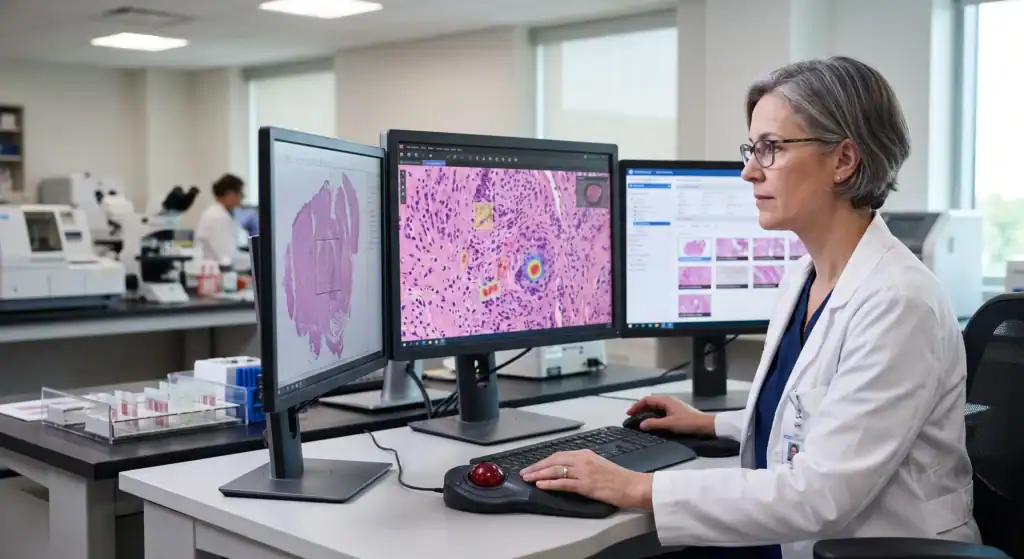
The most mature application of AI in laboratory medicine is digital pathology, where machine learning models analyze whole-slide images of tissue specimens. The performance data are encouraging. <cite index=”60-1″>A systematic review and meta-analysis from 2024 covering over 150,000 whole-slide images reported a combined mean sensitivity of 96.3 percent and specificity of 93.3 percent for AI in digital pathology,</cite> though the same analysis noted significant heterogeneity across studies and a risk of bias that tempers how those figures should be interpreted. <cite index=”60-1″>FDA-approved whole-slide imaging used with AI for primary diagnosis has signified a major milestone in the integration of computational pathology into clinical practice.</cite>
The practical value shows up most clearly in workflow efficiency. <cite index=”57-1″>AI-driven automation of routine tasks such as tissue segmentation, cell counting, and measurement reduces manual labor and human error, allowing pathologists to devote more time to complex cases.</cite> This matters enormously in a field where <cite index=”57-1″>pathologist burnout is rising due to workload and diagnostic complexity.</cite> When an algorithm pre-screens routine specimens and highlights the ones requiring expert attention, it does not replace the pathologist; it directs their finite attention to where it is most needed.
AI’s reach extends well beyond pathology. In clinical chemistry and hematology, machine learning enhances the autoverification and result validation processes that determine whether a result can be released automatically, learning from historical patterns to flag anomalies a rules-based system might miss. In microbiology, AI-assisted image analysis can pre-screen cultures and Gram stains. In molecular diagnostics, machine learning helps interpret the complex data generated by next-generation sequencing, including the challenging task of classifying genetic variants of uncertain significance. And across the laboratory, AI embedded in laboratory information systems supports predictive analytics, from forecasting critical values to optimizing specimen routing and workload distribution.
The commercial momentum reflects this expansion. Major diagnostics companies are embedding AI analysis applications directly into digital pathology platforms, pharmaceutical companies are partnering with AI developers to incorporate computational pathology into drug development and clinical trials, and the AI-in-pathology market continues to grow as precision medicine demand rises. The technology is moving from research novelty to routine infrastructure.
The Opportunities Worth Pursuing
The strongest case for AI in laboratory diagnostics rests on several genuine opportunities that align with the field’s most pressing needs.
The first is error reduction. Laboratory testing influences the majority of clinical decisions, and even small per-test error rates translate into large absolute numbers across billions of tests. AI systems that catch anomalies, flag implausible results, and reduce the manual transcription and interpretation steps where human error concentrates can meaningfully improve diagnostic reliability, particularly in the post-analytical phase where interpretation errors carry disproportionate clinical consequences.
The second is capacity. The laboratory workforce faces a structural shortage that current graduation rates cannot close, even as testing volume and complexity rise. AI that automates high-volume, repetitive tasks acts as a force multiplier, allowing a smaller workforce to handle a larger workload without a proportional increase in errors or turnaround time. This is not a substitute for addressing the workforce crisis, but it is a meaningful part of managing its consequences.
The third is access and equity. One of AI’s most compelling possibilities is the extension of expert-level interpretation to settings that lack specialists. A rural hospital or a laboratory in a low-resource country without an on-site pathologist could, in principle, use AI-assisted digital pathology to obtain preliminary interpretation that would otherwise require sending specimens long distances or forgoing timely diagnosis altogether. Realized responsibly, this capability could narrow rather than widen global diagnostic disparities, a goal central to organizations working on laboratory medicine access worldwide.
The fourth is precision medicine. As diagnosis increasingly depends on integrating complex, high-dimensional data, genomic profiles, biomarker panels, imaging, and clinical history, AI’s ability to find patterns across these data types supports the kind of individualized diagnosis and treatment selection that human analysis alone cannot easily achieve.
The Challenges That Cannot Be Ignored
For all its promise, AI in laboratory diagnostics comes with challenges that are technical, operational, and fundamental. Ignoring them would be both unwise and unsafe.
The most important technical challenge is generalizability. AI models frequently perform well on the data they were trained and tested on, then perform worse when applied to different patient populations, different instruments, or different institutions. Models trained and evaluated on homogeneous retrospective datasets often show inflated performance that does not hold up when validated across diverse, real-world settings. A model that achieves excellent accuracy at one academic center may falter at a community hospital with different demographics, staining protocols, or scanner hardware. This means that published accuracy figures cannot be taken at face value, and that local validation is essential before any AI tool enters clinical use.
Algorithmic bias is a related and serious concern. An AI system learns the patterns present in its training data, including any biases those data contain. If a model is trained predominantly on specimens from one demographic group, its performance may be worse for underrepresented groups, potentially producing less accurate diagnoses for exactly the populations already underserved by healthcare. Because reference intervals and diagnostic algorithms developed on non-representative populations can produce inequitable results, a diverse and vigilant workforce is needed to recognize when an AI tool may be encoding such bias.
Workflow disruption is a practical barrier that is easy to underestimate. Moving from glass-slide review to digital and AI-assisted workflows forces laboratories to redesign daily sign-out routines, case routing, and quality assurance steps. The technology does not simply drop into existing operations; it requires reengineering processes, retraining staff, and validating that the new workflow is at least as safe as the one it replaces.
Data quality and the pre-analytical phase remain foundational. An AI model is only as good as the data it receives, and a poorly collected or degraded specimen produces unreliable input regardless of how sophisticated the algorithm is. The quality of specimen collection and handling that determines the validity of any laboratory result determines the validity of AI-assisted results just as much.
The Ethical and Accountability Questions

Beyond the technical challenges lie ethical questions that the laboratory community, regulators, and society are still working through.
The question of accountability is central. When an AI system contributes to a diagnostic error, who is responsible? The pathologist who accepted its recommendation? The laboratory that deployed it? The company that built it? The consensus position in medicine is that AI should function as decision support rather than autonomous decision-maker, with a qualified professional retaining final responsibility. But as models become more capable and more trusted, there is a real risk of automation bias, the tendency to over-rely on an algorithm’s output and under-apply independent judgment. Maintaining meaningful human oversight, rather than reducing the human to a rubber stamp, is an ongoing challenge.
Transparency and explainability matter for trust. Many high-performing AI models are effectively black boxes, producing an output without an interpretable explanation of how they reached it. In a field where clinical decisions must be defensible and where understanding the basis of a result affects how a clinician acts on it, the opacity of some AI systems is a genuine limitation. Efforts to build explainable AI, systems that can indicate which features drove a conclusion, are an important area of work.
Patient privacy and data governance are heightened by AI, which depends on large volumes of patient data for training and operation. Ensuring that this data is used with appropriate consent, protected against breach, and governed transparently is both an ethical obligation and, given the cybersecurity risks facing laboratory systems, a practical necessity.
Finally, regulation is still catching up. The frameworks governing how AI diagnostic tools are validated, approved, monitored after deployment, and updated over time are evolving, and the pace of technological change often outstrips the pace of regulatory adaptation. Laboratories adopting these tools must navigate a landscape where the rules are still being written.
What Responsible Integration Looks Like
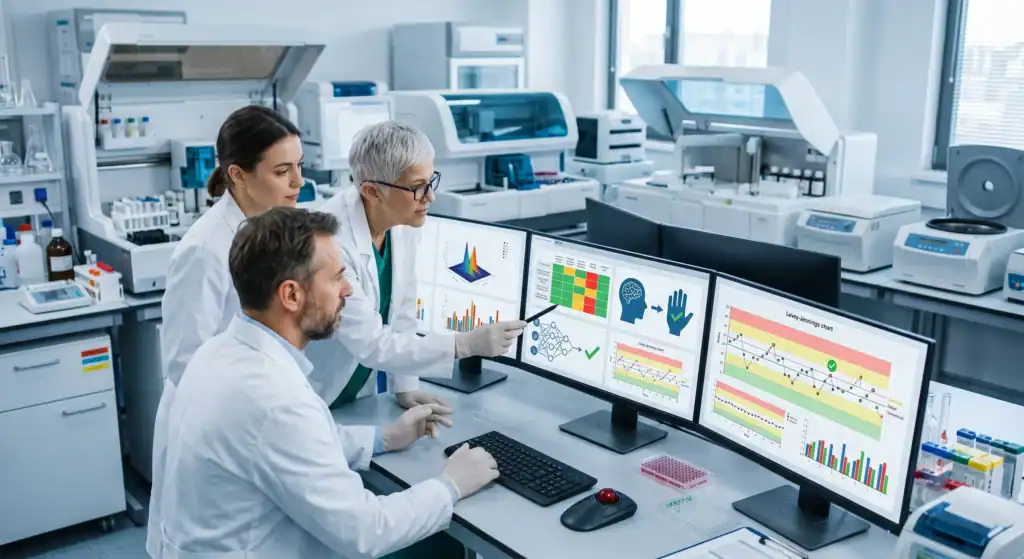
The path forward is neither uncritical enthusiasm nor reflexive resistance. It is disciplined, evidence-based integration that keeps laboratory professionals at the center.
Responsible integration begins with rigorous local validation: no AI tool should enter clinical use without being tested on the specific population, instruments, and workflows where it will operate, and its performance should be monitored continuously rather than assumed to remain stable. It requires maintaining genuine human oversight, with laboratory professionals empowered to question, override, and contextualize algorithmic output rather than defer to it automatically. It demands attention to equity, actively checking whether tools perform fairly across the full range of patients a laboratory serves. And it depends on transparency with patients and clinicians about where and how AI is being used in their care.
Crucially, responsible integration recognizes that AI amplifies the importance of laboratory expertise rather than diminishing it. Someone must validate these tools, monitor their performance, recognize their failures, interpret their output in clinical context, and take responsibility for the results. Those tasks require exactly the deep understanding of laboratory science, quality management, and clinical relevance that defines the laboratory professional. The technology handles pattern recognition at scale; the professional provides the judgment, context, and accountability that pattern recognition alone cannot supply.
Conclusion
Artificial intelligence is transforming laboratory diagnostics, and the transformation is genuine, not hype. In digital pathology, clinical chemistry, microbiology, and molecular diagnostics, AI is already reducing routine burden, catching errors, and helping an overstretched workforce manage rising demand. Its potential to extend expert interpretation to underserved settings and to power precision medicine is real and worth pursuing.
But the challenges are equally real. Generalizability failures, algorithmic bias, workflow disruption, accountability gaps, and unsettled regulation all demand careful attention. The tools are powerful, but they are not infallible, and they are not autonomous. The future of laboratory diagnostics is not one where AI replaces laboratory professionals, but one where laboratory professionals, equipped with AI and disciplined about its limits, deliver faster, more accurate, and more accessible diagnosis than either humans or machines could achieve alone. Getting there responsibly is the defining task of the field’s next decade.
Bio-Reach is a non-profit organization dedicated to advancing Laboratory Medicine through advocacy, education, and global collaboration. To learn more or get involved, visit bio-reach.org.