Ask a room of high school students to name careers in healthcare, and the answers come quickly: doctor, nurse, pharmacist, maybe dentist or physical therapist. Almost none will say medical laboratory scientist. Yet the professionals who hold that title, and the technicians who work alongside them, generate the data behind the overwhelming majority of medical decisions those doctors and nurses make. This disconnect between the profession’s importance and its visibility is not a trivia problem. It is the root cause of a workforce crisis that threatens the reliability of diagnostic testing, and the most powerful place to solve it is in the classroom.
Laboratory medicine is invisible in a way that few other essential professions are. Unlike nursing or pharmacy, laboratory science does not have broad public awareness, and high school guidance counselors and college advisors often do not know the field exists as a career path. Students who are naturally drawn to science never learn that medical laboratory science is an option. The consequence is a pipeline that cannot keep pace with demand, even as the work itself grows more essential every year.
This article makes the case that laboratory medicine belongs in the curriculum, examines the workforce crisis that classroom exposure could help solve, and describes what effective early education in laboratory science looks like and why it matters for the future of healthcare.
The Scale of the Workforce Crisis
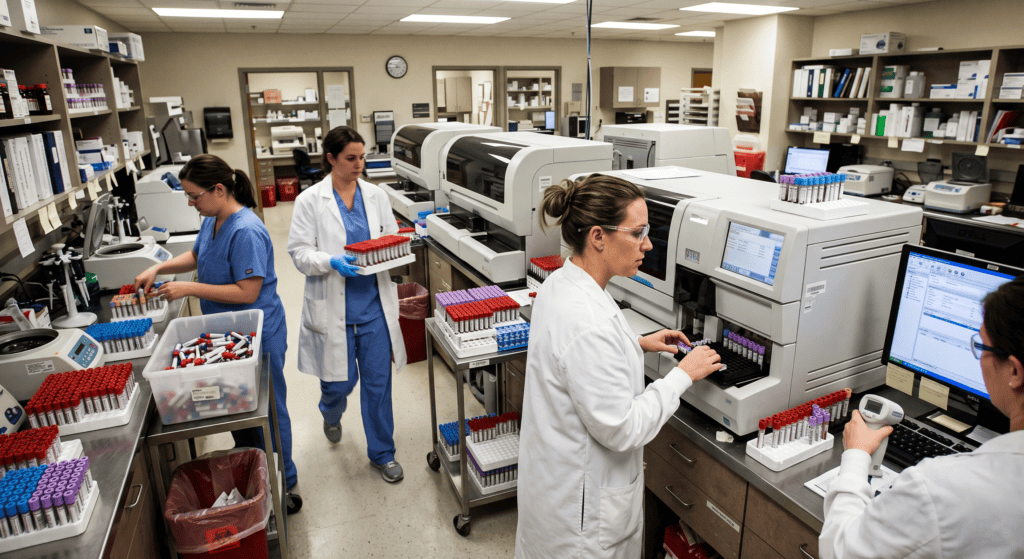
The numbers behind the laboratory workforce shortage are stark and worsening. According to the Bureau of Labor Statistics, the field currently has about 351,200 employed clinical laboratory technologists and technicians, with roughly 22,600 openings projected each year, on average, between 2024 and 2034. Most of that demand comes from the need to replace workers who retire or leave the field faster than new professionals enter it.
The supply side cannot meet that demand. The American Society for Clinical Laboratory Science has stated directly that the profession is educating less than half of the number of laboratory professionals needed. With approximately 4,900 students graduating annually from laboratory programs while there are over 9,000 job openings, this creates a substantial vacancy gap even before accounting for retirements. The training infrastructure is shrinking rather than growing: the number of accredited medical laboratory training programs has declined by 15 percent over the past decade, and the United States and Canada are currently short an estimated 20,000 to 25,000 laboratory professionals.
The reasons programs close compound the problem. Laboratory science curricula are expensive to operate, requiring specialized equipment, faculty, and clinical placement sites. When universities face budget pressures and see low enrollment, driven in part by students not knowing the field exists, these programs become targets for elimination. This creates a vicious cycle: low awareness produces low enrollment, low enrollment justifies program cuts, and fewer programs mean fewer graduates and even less visibility for the profession.
Meanwhile, demand for laboratory services keeps rising. An aging population requires more diagnostic testing for conditions like cancer and diabetes. The expansion of molecular diagnostics and genetic testing has broadened test menus and increased the technical complexity of laboratory work. The result is a profession being asked to do more with fewer people, a situation that lengthens turnaround times, increases the risk of errors from overworked staff, and accelerates burnout among those who remain.
Why the Classroom Is the Right Place to Intervene
The single most cited driver of the laboratory workforce shortage is not compensation, working conditions, or educational cost, though all of these matter. It is awareness. The profession is invisible to the young people who might choose it, and that invisibility begins early, long before a student selects a college major.
The evidence strongly supports early intervention. Workforce experts consistently recommend that outreach efforts begin as early as middle school, in cooperation with existing STEM programs, to bring awareness of the profession to both students and the K-12 educators who advise them. When students who are naturally drawn to biology and chemistry learn that laboratory medicine offers a rigorous, intellectually engaging, and secure career with a direct connection to patient outcomes, many choose to pursue it. But they can only make that choice if they know it exists.
The gatekeepers matter as much as the students. Guidance counselors and college advisors shape the career awareness of thousands of students, yet most have never been exposed to laboratory medicine as a career option. Recognizing this, professional organizations have begun attending conferences for high school and college career counselors, bringing hands-on demonstration kits, developed with support from the CDC, that let counselors simulate basic blood bank and microbiology work. When the advisors understand the field, they can direct interested students toward it. This is a scalable insight: reaching one counselor can influence dozens of students over the years.
Early exposure also addresses equity. Students from underrepresented and underserved communities are least likely to have family connections or informal networks that introduce them to niche healthcare careers. Bringing laboratory science into schools, particularly schools serving these communities, opens a pathway to a stable, well-credentialed profession for students who might otherwise never encounter it. This is precisely the gap that mission-driven programs are designed to close.
What Effective Early Education Looks Like
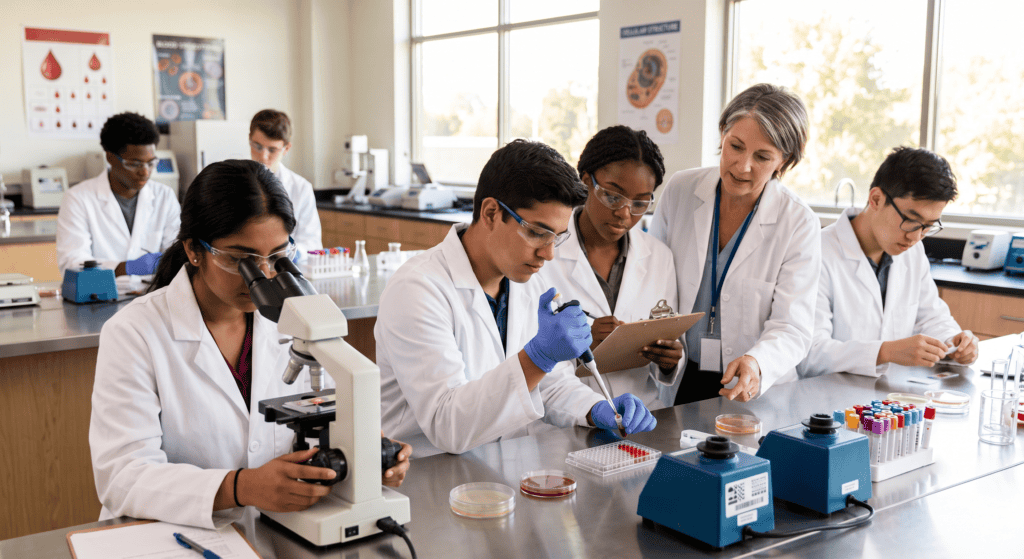
Introducing laboratory medicine to students is not a matter of adding a textbook chapter. The profession is fundamentally hands-on, and the most effective outreach reflects that. Programs that bring laboratory professionals into classrooms to demonstrate real techniques, pipetting, microscopy, blood typing, rapid test interpretation, consistently generate more interest than lectures about career statistics. When a student performs a simulated blood bank crossmatch or identifies bacteria under a microscope, the abstract idea of laboratory work becomes concrete and compelling.
Several models have demonstrated impact. Career days and health fairs that include laboratory science alongside the more familiar healthcare professions spark initial interest. Introductory training courses and immersion experiences teach foundational skills while providing career shadowing. Phlebotomy certification programs at the high school level offer a particularly powerful entry point, since they provide a tangible, employable credential, an understanding of proper specimen collection technique, and a first step into the laboratory workforce that a student can take immediately after graduation. A teenager who becomes a certified phlebotomist has both a job and a foothold in a field they can build a career in.
Larger structural investments are emerging as well. Significant philanthropic funding has gone toward building new high schools with specialized healthcare classes and work-based learning programs, creating opportunities for students to earn industry-recognized credentials and enter the healthcare workforce directly after graduation. These models point toward a future where laboratory science is a visible, accessible option within the standard educational landscape rather than a field discovered by accident.
Bio-Reach’s own Lab Lit program embodies this approach, partnering with schools to provide age-appropriate laboratory education and inspire the next generation of scientists, with a particular focus on students from communities historically underrepresented in healthcare. Programs like this recognize that the workforce crisis is, at its heart, an awareness and access problem that classroom exposure is uniquely positioned to solve.
The Broader Case: Scientific Literacy for Everyone

The argument for teaching laboratory medicine in schools does not rest solely on workforce recruitment. There is a broader public benefit to helping all students understand how diagnostic testing works, even those who will never pursue it as a career.
Every person will be a patient. Every person will, at some point, have blood drawn, receive test results, and make health decisions based on laboratory data. A population that understands what a laboratory test measures, why specimen quality matters, what a reference range means, and why results require professional interpretation is a population better equipped to participate in its own healthcare. As direct-to-consumer testing puts diagnostic information directly into consumers’ hands, this kind of literacy becomes more valuable, not less. A student who learns how laboratory testing works becomes an adult who can interpret their own health data more wisely.
Teaching laboratory medicine also reinforces general scientific reasoning: the importance of controlled conditions, the difference between correlation and causation, the concept of measurement uncertainty, and the value of standardized quality processes. These are transferable habits of mind that serve students regardless of the careers they ultimately choose.
What Is at Stake
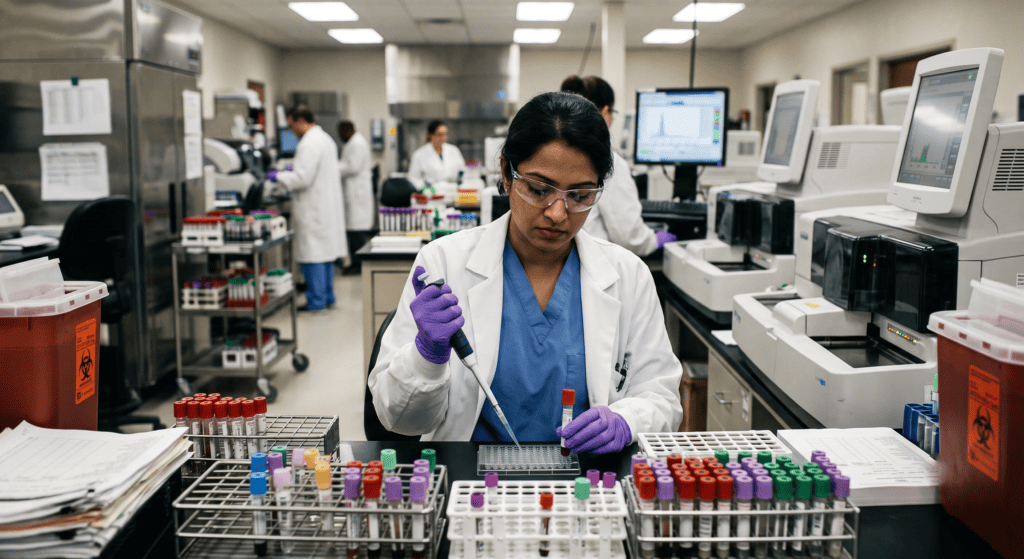
The consequences of failing to build the laboratory workforce pipeline are not abstract. When laboratories are understaffed, patients wait longer for the results that guide their diagnoses and treatments. Overworked staff face higher risk of error, precisely in a field where errors carry serious clinical consequences. Quality standards become harder to maintain. And the institutional knowledge held by retiring professionals, the hard-won expertise that lets a seasoned scientist recognize an unusual result or troubleshoot an obscure problem, walks out the door without being passed on.
These outcomes are preventable, but not quickly. The pipeline takes years to fill. A student inspired in middle school will not staff a laboratory bench for the better part of a decade. This is precisely why early intervention is urgent rather than optional: the sooner young people discover laboratory medicine, the sooner the profession can begin closing a gap that current graduation rates cannot close on their own. Legislative efforts to support laboratory training and loan repayment are encouraging signals, but policy moves slowly, and no funding mechanism can recruit students who have never heard of the field.
Teaching laboratory medicine in schools is one of the highest-leverage, lowest-cost interventions available. It does not require new technology or major infrastructure. It requires bringing the profession into the rooms where young people decide what to become, and letting them see, with their own hands, work that matters.
Conclusion
The laboratory workforce shortage is a structural crisis with a deceptively simple root cause: young people cannot choose a profession they do not know exists. Every school that introduces laboratory medicine, through hands-on demonstrations, phlebotomy programs, career fairs, or partnerships with laboratory professionals, plants seeds that can grow into the diagnostic workforce of the future. The investment pays off not only in recruitment but in a more scientifically literate public better equipped to navigate its own healthcare.
Laboratory medicine drives the majority of medical decisions, yet it remains one of healthcare’s best-kept secrets. Making it visible in the classroom is not merely a nice idea for the profession. It is a necessary step toward a healthcare system with the diagnostic capacity to serve a growing, aging population. The next generation of laboratory scientists is sitting in classrooms right now, waiting to discover a career they have never heard of. It is up to educators, laboratory professionals, and advocacy organizations to make sure they do.
Bio-Reach is a non-profit organization dedicated to advancing Laboratory Medicine through advocacy, education, and global collaboration. To learn more or get involved, visit bio-reach.org.