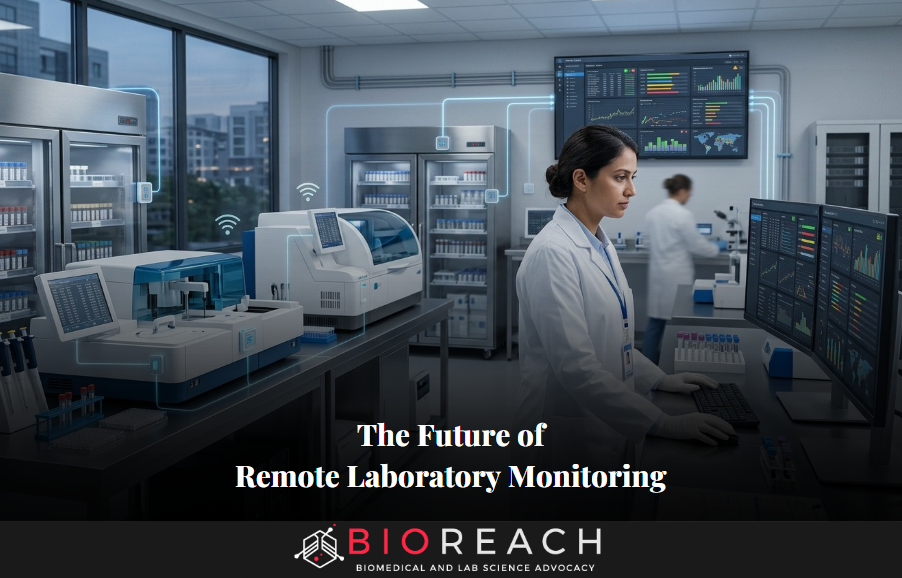
Laboratory Technology enables remote laboratory monitoring by connecting instruments, storage systems, quality control processes, testing devices, and image review tools so problems can be detected and addressed without someone standing at the bench. It includes cloud-connected temperature sensors on freezers, middleware that tracks point-of-care devices and operators in real time, patient-based quality control that detects result drift between scheduled control runs, and remote review of digital images.
However, regulation and validation set the pace: on September 23, 2025, the Centers for Medicare & Medicaid Services issued a memorandum ending its temporary allowance for remote review of digital cytology images without a separate CLIA certificate at the remote site, with compliance due by March 23, 2026. This highlights that laboratory technology advances only as quickly as the quality systems and regulations that support it.
For most of the history of clinical laboratories, monitoring meant physical presence: a technologist checked the freezer log, plotted the control results, and walked to the analyzer when an alarm sounded. Connected sensors, middleware, and statistical tools now allow much of that watching to happen continuously and remotely, which matters at a time when laboratories are stretched thin, and testing is moving beyond the central laboratory. This article explains what remote laboratory monitoring includes, where it protects specimens and quality, how it applies to point-of-care testing, where regulation draws the line for remote review, and what laboratories should weigh as they adopt it.
What Laboratory Technology Enables in Remote Laboratory Monitoring
Laboratory Technology supports remote monitoring through a set of distinct capabilities built around one core idea: collect data automatically, transmit it to a system where people or algorithms can act on it, and maintain a reliable record. The first capability is environmental and equipment monitoring, which tracks the temperature and status of freezers, refrigerators, and incubators that store specimens and reagents. The second is analytical monitoring, which evaluates test performance using control materials and, increasingly, patient results themselves.
The third capability is device and operator monitoring, which matters most in point-of-care testing, where many handheld devices are operated by staff outside the laboratory. The fourth is remote review of digital images, such as whole-slide images in pathology, which lets qualified professionals interpret cases from a different location. Each capability has its own evidence base and its own regulatory considerations, which is why a laboratory rarely adopts all four at once. These capabilities build on the wider shift toward connected laboratories described in how startups are transforming laboratory medicine.
Protecting Specimens and Keeping Instruments Running
Storage failures are among the most avoidable causes of lost specimens, and remote temperature monitoring is the most established form of remote laboratory monitoring. A description published in Lab Manager, sponsored by the vendor Minus80 Monitoring, outlines the typical design: a cloud-based wireless system with a web portal and mobile app showing real-time temperatures and door status, alerts sent by text, email, or voice to designated staff, and archived data with ready reports for compliance. Because the article is vendor-sponsored, its claims should be read as a description of the approach rather than independent evidence of performance.
The practical value is illustrated in the same article by a user at Duke, where freezers held at -80°C, -20°C, and -140°C were monitored and where a -80°C freezer that warmed to -55°C and a -20°C freezer opened about 20 times an hour were used as examples. Door-event data helps staff tell a genuine equipment problem from heavy routine use, which can save an unnecessary trip to the laboratory. The article gives no sensor accuracy, response time, or uptime figures, so laboratories evaluating systems should request those details directly.
Instrument monitoring follows similar logic. An article in Clinical Laboratory Products on managing analyzer downtime notes that analyzer downtime can delay results and disrupt patient care, and that laboratories are responding with backup analyzers, middleware that can reroute work to available instruments, service contracts that cover regular maintenance, and predictive analytics that monitor performance metrics and error-code patterns to anticipate failures. The article offers no quantitative downtime data, so these are best seen as practices to consider rather than proven percentage gains. They connect to the broader theme of diagnostic quality assurance, where preventing a failure is cheaper and safer than recovering from one.
Monitoring Analytical Quality in Real Time
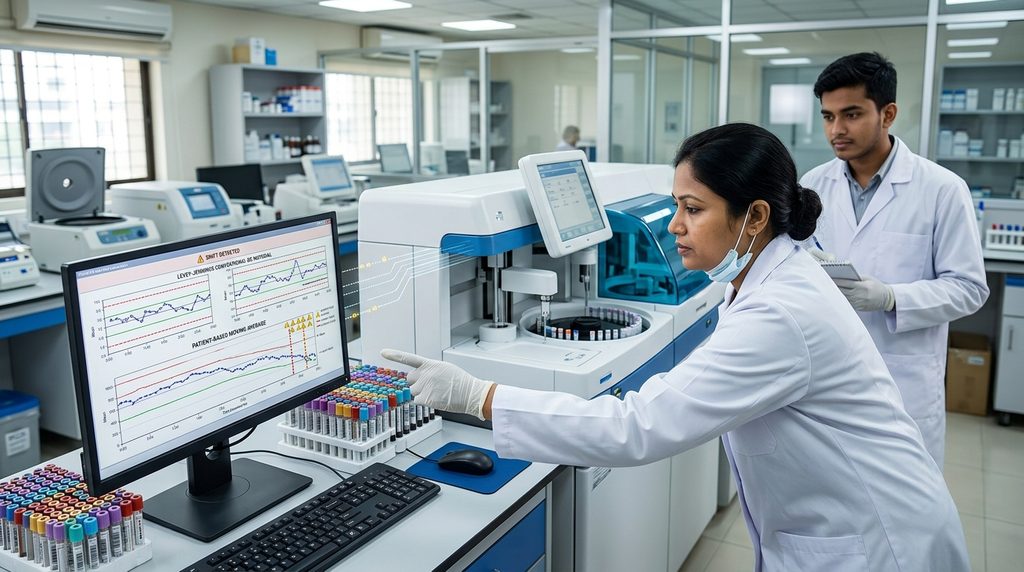
Traditional internal quality control in Laboratory Technology checks a test at fixed intervals using control materials, meaning an error that develops between runs can affect patient results before it is caught. Patient-based real-time quality control (PBRTQC) addresses this by monitoring actual patient results, using statistical tools such as moving averages and moving medians to detect shifts as they occur. The IFCC Committee on Analytical Quality has published recommendations on verifying PBRTQC performance before laboratories rely on it.
The recommendation is practical. It advises dividing historical data into training and verification sets, with most data used for training, and collecting at least 6 months of data, ideally a year or more, to represent weekends, seasonal patterns, and at least two reagent or calibrator lots. Laboratories should measure two things: the false-positive rate, which must remain manageable, and the average number of patient results affected before an error is detected, ideally fewer than the number of samples between internal quality control runs. The paper acknowledges a trade-off: settings that detect errors faster generally increase the false-positive rate.
Because PBRTQC is a monitoring layer that works continuously and does not require extra control material for every check, it fits naturally into a remote monitoring strategy, but it does not replace traditional controls. The recommendation frames it as a way to improve error detection beyond current internal QC practice, and it stresses documentation of data sources, parameters, software version, and verification results. For laboratory professionals, that means the skills involved are shifting toward statistics and data stewardship, a trend that also appears in the discussion of artificial intelligence and the future of laboratory diagnostics.
Connected Devices and Point-of-Care Testing
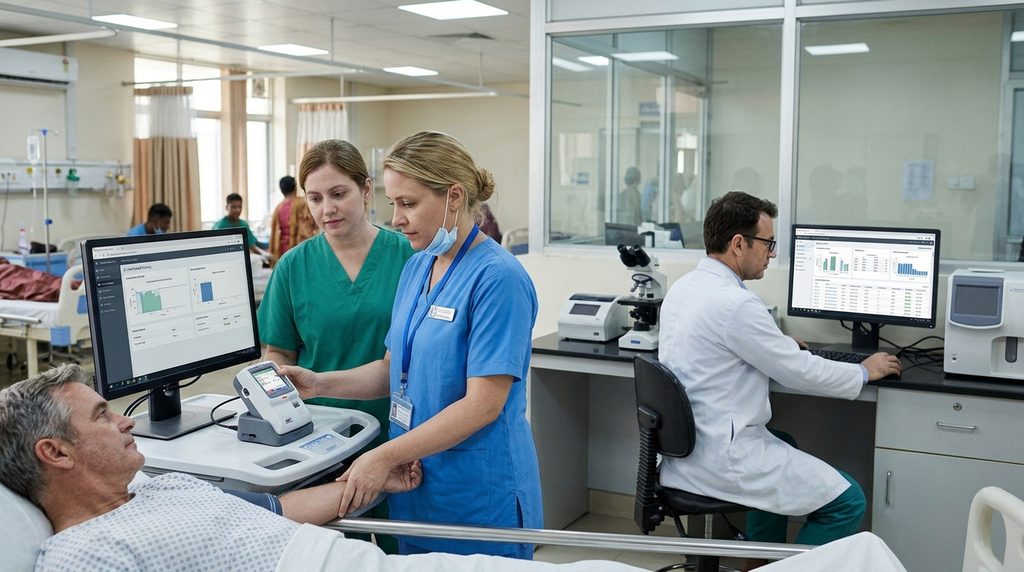
Point-of-care testing is where remote monitoring solves a very practical problem. An Association for Diagnostics & Laboratory Medicine article on instrument connectivity explains that many handheld devices are deployed outside the laboratory, that nonlaboratory staff often perform the testing, and that this creates training and quality control compliance challenges. It identifies a need to monitor devices, testing personnel, quality control, and patient results in real time, and it describes middleware as the means of meeting that need, including an open, hospital-wide approach that lets a laboratory manage multiple point-of-care vendors through one solution.
Standards and interfaces matter here. The same article notes that point-of-care interfaces use HL7 rather than the older ASTM standard because patient demographics must be available before testing, and that middleware shields laboratories from the differences between instrument and laboratory information system vendors. The result is stable connectivity and better control of compliance with CLIA requirements across a distributed testing program.
This connectivity also underpins newer care models. As testing moves closer to patients through telehealth and home collection, the data from those settings must still flow into systems that the laboratory can monitor and trust, a shift explored in how telehealth is increasing demand for laboratory services and home-based laboratory testing. Remote monitoring is part of what allows quality to travel with the test.
Remote Review and the Regulatory Boundary
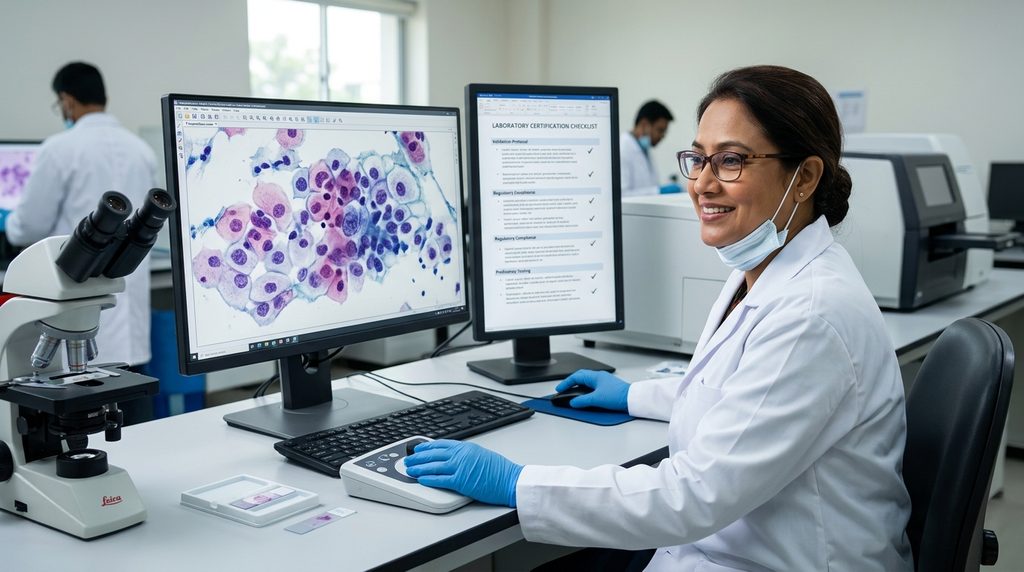
Remote review of digital images shows both the promise and the limits of remote laboratory work. During the COVID-19 public health emergency, CMS used temporary enforcement discretion to allow remote review of digital cytology images without a separate CLIA certificate at the remote location. On September 23, 2025, CMS released revised guidance ending that discretion, explaining that the CLIA statute requires cytological screening to be done on the premises of a certified laboratory and that it lacks the authority to make the pandemic flexibilities permanent.
Under the guidance, laboratories that want to continue reviewing digital cytology images from an off-site location must hold a separate CLIA certificate for that location, with a compliance date of March 23, 2026. The change applies to cytology only, and CMS said remote review of digital surgical pathology slides is not affected as long as the primary site holds the right certificate. The American Society for Clinical Pathology met with CMS in February 2026 and asked it to restore remote review authority, arguing that the statute requires screening to occur in the laboratory but does not require interpretations to be done there, and it expected a response to take at least several months.
The sources available to me do not confirm what has happened since March 2026, so any laboratory relying on remote cytology review should check current CMS and College of American Pathologists guidance before making decisions. The broader lesson holds regardless: remote capability depends on a regulatory foundation, and technology that is possible is not always technology that is permitted.
Conclusion
Remote laboratory monitoring is already practical in several forms: connected sensors that guard specimens, middleware that supervises point-of-care devices and operators, patient-based statistical controls that catch drift sooner, and digital review tools that extend access to expertise where regulations allow. The common benefit is earlier detection and better documentation, which supports both patient safety and compliance.
What will determine how far it goes is not only the technology but the surrounding discipline: verification before deployment, clear documentation, staff with the skills to interpret the data, and attention to regulatory boundaries. Laboratories that treat laboratory technology as a quality tool rather than a gadget, and that invest in people as well as sensors, will be best placed to benefit.
Frequently Asked Questions
What is remote laboratory monitoring?
Remote laboratory monitoring is the use of connected technology to observe laboratory instruments, storage conditions, quality control, testing devices, and sometimes image review from a distance. It typically sends alerts to staff, archives data for compliance, and allows problems to be addressed before they affect specimens or patient results.
How does remote temperature monitoring protect laboratory specimens?
Wireless sensors on freezers and refrigerators report temperature and door status in real time to a web portal or mobile app and send alerts by text, email, or voice when readings drift. Door-event data helps staff tell a real equipment failure from heavy routine use, and archived data supports compliance reporting.
What is patient-based real-time quality control?
Patient-based real-time quality control monitors the results patients receive, using statistical tools such as moving averages, to detect problems between scheduled control runs. The IFCC recommends verifying its performance before use, including at least 6 months of training data and measuring both the false-positive rate and how many patient results are affected before an error is detected.
Can pathologists review digital cytology images remotely?
Under CMS guidance issued September 23, 2025, laboratories must hold a separate CLIA certificate for any remote location where digital cytology images are reviewed, with a compliance date of March 23, 2026. Remote review of digital surgical pathology slides was not affected, and professional societies have asked CMS to reconsider, so laboratories should confirm the current status.
How does remote monitoring help point-of-care testing?
Middleware connects handheld devices to the laboratory information system and allows real-time monitoring of devices, operators, quality control, and patient results. This helps laboratories manage training and CLIA compliance across many sites where nonlaboratory staff perform testing.
Bio-Reach is a non-profit organization dedicated to advancing Laboratory Medicine through advocacy, education, and global collaboration. To learn more or get involved, visit bio-reach.org.