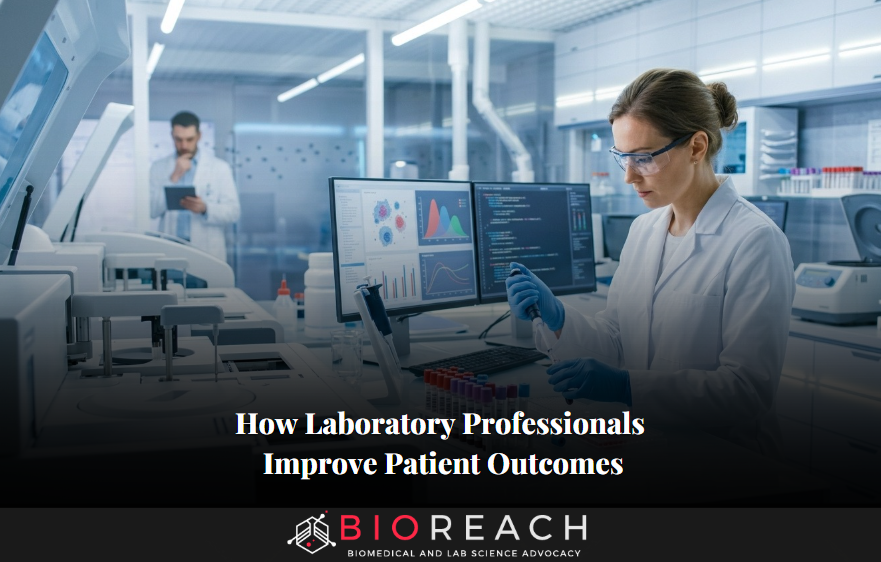
Laboratory Medicine plays a vital role in improving patient outcomes by ensuring the right tests are ordered, specimens are collected and handled correctly, results are accurate, and findings reach clinicians in time to guide treatment decisions. The scale of this work is significant. The United States performs an estimated 13 billion laboratory tests annually, based on a 2014 Federal Register estimate.
According to the Bureau of Labor Statistics, more than 350,000 clinical laboratory technologists and technicians were employed in 2024, while approximately 320,000 sites were registered under CLIA as of March 2024. The impact of laboratory medicine extends beyond these numbers, with evidence showing how laboratory professionals help identify bloodstream infections faster, prevent lost or delayed critical results, and reduce errors throughout the testing process.
Patients rarely meet the people who run their tests, yet nearly every diagnosis, treatment adjustment, and safety check depends on them. A result that is late, mislabeled, or never communicated can change a patient’s course just as surely as a result that is wrong. This article explains what laboratory professionals actually do, examines how much laboratory medicine really drives clinical decisions, looks at the evidence from rapid diagnostics, shows where errors arise and how professionals prevent them, and considers why a strong workforce matters for outcomes.
The Essential Role of Laboratory Medicine Professionals Behind the Scenes
Laboratory medicine involves much more than running tests. Medical laboratory scientists and technologists verify specimens, confirm patient identity, check sample quality, perform quality control, troubleshoot instruments, and review unusual results. They also determine when a test needs to be repeated or when a critical result must be communicated to a clinician immediately. Phlebotomists, pathologists, laboratory managers, and informatics staff contribute their expertise throughout the process, helping ensure accurate results and timely decisions that support better patient care.
Each step is a point where outcomes can be protected or lost. Specimen collection and handling decide whether a result reflects the patient’s physiology or a preventable artifact, a theme examined in the Bio-Reach discussion of the hidden cost of diagnostic errors. Quality control and verification decide whether the number reported is trustworthy, and communication decides whether the right person acts on it in time. Because most of this happens behind the scenes, the profession’s contribution is often invisible, which is the problem described in creating awareness for healthcare’s hidden profession.
How Much Do Laboratory Results Really Drive Care?

A figure frequently quoted in laboratory advocacy is that laboratory tests influence about 70 percent of medical decisions, and it deserves a careful look because it shapes how the profession describes its value. The claim traces back to a 1996 Clinical Chemistry article that described the laboratory as leveraging 60 to 70 percent of critical decision-making, but the author offered no direct evidence, and later reviews of the claim found little to support a precise number.
More recent studies give a range of answers that depend on how influence is measured. A 2016 study of cardiology and oncology physicians in the United States and Germany reported that 66 percent of their medical decisions were based on laboratory testing, although the figure reflected physician perception rather than recorded decisions.
A 2017 analysis of about 72,000 encounters at one academic medical center found that 35 percent of encounters included at least one laboratory order, with 98 percent of inpatient encounters, 56 percent of emergency department encounters, and 29 percent of outpatient encounters involving testing, and its authors concluded that no single number captures how often tests matter. A 2020 review of cardiology guidelines found that 73 to 94 percent of guidelines from four international organizations recommended laboratory testing for diagnosing or treating cardiovascular disease.
The honest conclusion is that laboratory medicine is central to care, but its influence varies sharply by setting and condition, and the more defensible way to make the case is with verifiable data. The American Society for Clinical Laboratory Science has made the same point, encouraging members to cite measurable facts about the profession, such as workforce size and test volume, rather than a number that cannot be sourced. That approach also strengthens the argument, because the specific evidence below is more persuasive than any round percentage.
Speed and Accuracy: Rapid Diagnostics and Stewardship

Some of the clearest evidence of laboratory impact comes from infectious disease, where the time to identify an organism determines how quickly a patient receives the right antibiotic. A pre-post study published in Clinical Infectious Diseases compared 245 adults with bacteremia or candidemia treated after a rapid-identification and stewardship intervention with 256 patients treated before it. Time to organism identification fell from 84.0 hours to 55.9 hours, time to effective therapy fell from 30.1 to 20.4 hours, and time to optimal therapy fell from 90.3 to 47.3 hours, while ICU length of stay was shorter in the intervention group (8.3 days versus 14.9 days) and recurrent bacteremia was less common (2.0 percent versus 5.9 percent).
The study combined faster laboratory identification with a stewardship team that gave real-time recommendations, so the benefit cannot be credited to the laboratory alone, and its design used a historical comparison group, which limits how firmly the results can be attributed to the intervention. On mortality, the authors reported a lower rate in the intervention group on simple comparison, but the independent effect of following stewardship recommendations did not reach statistical significance in the adjusted analysis. What the study does show clearly is how much faster the right information can reach the bedside when the laboratory and the clinical team work together.
Why timing matters is illustrated by a widely cited 2006 retrospective cohort of 2,731 patients with septic shock in the United States and Canada. Each hour of delay in starting an effective antimicrobial after the onset of low blood pressure was associated with an average 7.6 percent increase in mortality, with a median delay of 6 hours and overall mortality of 56.2 percent. The data come from patients enrolled between 1989 and 2004, and observational design and changes in practice over time mean the per-hour estimate should be read as an association, but the message is consistent with the logic of rapid diagnostics: when the laboratory shortens the path to an effective drug, patients benefit.
Preventing Errors Before and After the Test

Laboratory professionals also improve outcomes by preventing harm that never appears in a result. A review of critical value notification in Biochemia Medica noted that analytical errors have decreased significantly over recent decades, while the steps before and after the analyzer are more error-prone and often occur outside direct laboratory control. Among the studies it cites, failure to order appropriate diagnostic tests accounted for 55 percent of breakdowns in missed or delayed diagnosis in ambulatory settings and 58 percent in the emergency department.
Communication failures are an equally important risk. The same review cites evidence that clinically significant abnormal results were not communicated to patients in about 1 of every 14 tests, and that in a 24-hour observation of patient care, 10.9 percent of critical care items were lost because of communication failures, with critical laboratory values accounting for 36.1 percent of those lost items. These figures come from earlier studies in specific settings, so they should be read as illustrations rather than universal rates, but they explain why laboratories build structured processes for identifying and escalating critical results, and why accreditation standards require timely reporting.
This is also where laboratory professionals add value that automation alone cannot supply. Recognizing a specimen that does not look right, questioning a result that conflicts with the clinical picture, and picking up the phone when a critical value appears are judgment-based actions, and they sit within the broader post-analytical phase of laboratory testing that determines whether a result becomes a decision. Rigorous diagnostic quality assurance gives that judgment a structure, so that quality does not depend on any one person’s vigilance.
Why a Strong Workforce Matters for Outcomes

All of this depends on having enough trained people. The American Society for Clinical Pathology’s 2024 vacancy survey found that vacancy rates have declined since 2022 but remain above pre-pandemic levels, that 10 of the 17 laboratory departments surveyed reported rising retirements, and that recruiting and retaining qualified laboratory professionals remains difficult. The survey’s respondents called for stronger advocacy for laboratory professionals, expanded credentialing, and more training programs.
When laboratories are understaffed, the effects reach patients through longer turnaround times, thinner coverage for quality oversight, and fewer people available to investigate unusual results, which is why the consequences are explored in the economic impact of laboratory workforce shortages. Building the pipeline starts early, with efforts such as introducing laboratory science to middle school students and building a diverse laboratory workforce for the future, and it continues through the education-to-employment pathways discussed in bridging the gap between education and employment in laboratory science.
Conclusion
Laboratory professionals improve patient outcomes through a chain of specific, verifiable contributions: protecting specimen quality, ensuring accurate results, speeding identification of infections so that effective treatment starts sooner, and making sure critical results are noticed and acted on. The evidence is strongest where it is most specific, in studies of rapid diagnostics and communication, and weaker where it relies on broad claims about the share of decisions that depend on testing.
That distinction matters for how the profession speaks about itself. Laboratory medicine does not need an unsourced percentage to justify its importance, because the documented effects on time to treatment, error prevention, and patient safety already make the case. Protecting that contribution requires investing in the workforce that delivers it.
Frequently Asked Questions
How do laboratory professionals improve patient outcomes?
They ensure specimens are collected and handled correctly, run and monitor quality control, verify that results are accurate, and communicate critical findings quickly. In infectious disease, faster organism identification combined with antimicrobial stewardship has been shown to shorten the time to effective therapy, for example, from 30.1 to 20.4 hours in one hospital study.
Do laboratory tests really influence 70 percent of medical decisions?
The 70 percent figure is widely repeated but weakly sourced. It traces to a 1996 article that offered no direct evidence, and later studies give different answers depending on method: 66 percent in a physician perception study, 35 percent of encounters including a laboratory order in a single-center analysis, and 73 to 94 percent of cardiology guidelines recommending laboratory testing.
Why does speed matter in laboratory testing?
Speed determines how soon patients receive appropriate treatment. In a retrospective study of septic shock, each hour of delay in effective antimicrobial therapy was associated with an average 7.6 percent increase in mortality, which shows why rapid identification and reporting of organisms and critical results matter.
What kinds of errors do laboratory professionals prevent?
They help prevent pre-analytical errors such as poor specimen collection, analytical errors such as instrument or quality control problems, and post-analytical errors such as delayed or lost critical results. Research cited in a Biochemia Medica review found that steps outside the analyzer are more error-prone than the analytical phase.
How does the laboratory workforce shortage affect patients?
Staffing gaps can slow turnaround times, reduce quality oversight, and leave fewer people to investigate unusual results. The American Society for Clinical Pathology’s 2024 survey found vacancy rates still above pre-pandemic levels, with 10 of 17 departments reporting rising retirements.
Bio-Reach is a non-profit organization dedicated to advancing Laboratory Medicine through advocacy, education, and global collaboration. To learn more or get involved, visit bio-reach.org.