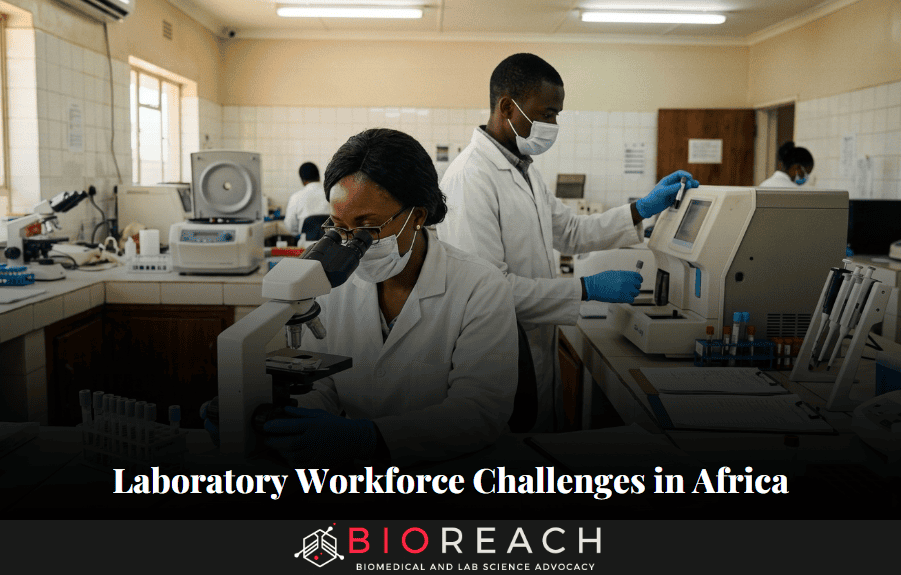
Laboratory workforce challenges in Africa are the combined result of too few trained professionals, limited training and continuing-education capacity, chronic underfunding, difficulty retaining staff, and weak professional recognition and regulation. A WHO study of 47 countries in its African Region found only 1.55 physicians, nurses, and midwives per 1,000 people, and it projected that the regional health worker shortage will reach 6.1 million by 2030, a 45 percent increase from the 2013 estimate. Laboratory personnel make up roughly 10 percent of that already thin workforce, which means every gap in training, pay, or retention is felt directly in how quickly and how accurately patients are diagnosed.
Laboratory testing sits behind most clinical decisions, yet the people who run it are rarely counted, funded, or recognized in proportion to their role. In many African health systems, a shortage of laboratory professionals not only slows results; it limits which tests a facility can offer at all and weakens the quality systems that make results trustworthy. This article explains what the main laboratory workforce challenges in Africa are, how migration and retention make them worse, which programs are making a measurable difference, and what closing the gap will require.
Why the Laboratory Workforce Is Stretched So Thin
The WHO’s regional workforce data make the scale of the shortage clearest. The 2022 cross-sectional study published in BMJ Global Health found that only four countries (Mauritius, Namibia, Seychelles, and South Africa) had surpassed the WHO health worker-to-population benchmark, and that density ranged from 0.25 health workers per 1,000 people in Niger to 9.15 per 1,000 in the Seychelles. The same study reported that laboratory personnel account for about 10 percent of the regional health workforce, compared with 37 percent for nurses and midwives and 9 percent for medical doctors.
The WHO attributes this long-standing shortage to several overlapping causes: inadequate training capacity, rapid population growth, international migration, weak governance of the health workforce, career changes, and poor retention. None of these causes is unique to laboratories, but laboratories feel them acutely because the profession is small, less visible to policymakers, and often treated as a support function rather than a clinical one. This pattern connects directly to the broader economic impact of laboratory workforce shortages, where unfilled laboratory positions translate into delayed diagnoses and avoidable costs.
Geography adds another layer. Workforce analyses of sub-Saharan Africa note that countries struggle to attract and retain health workers in rural areas, where roughly 60 percent of the population lives, so the shortage is felt most sharply in the communities that already have the least access to testing. That gap mirrors the challenge described in why rural communities need better diagnostic access.
The Core Laboratory Workforce Challenges
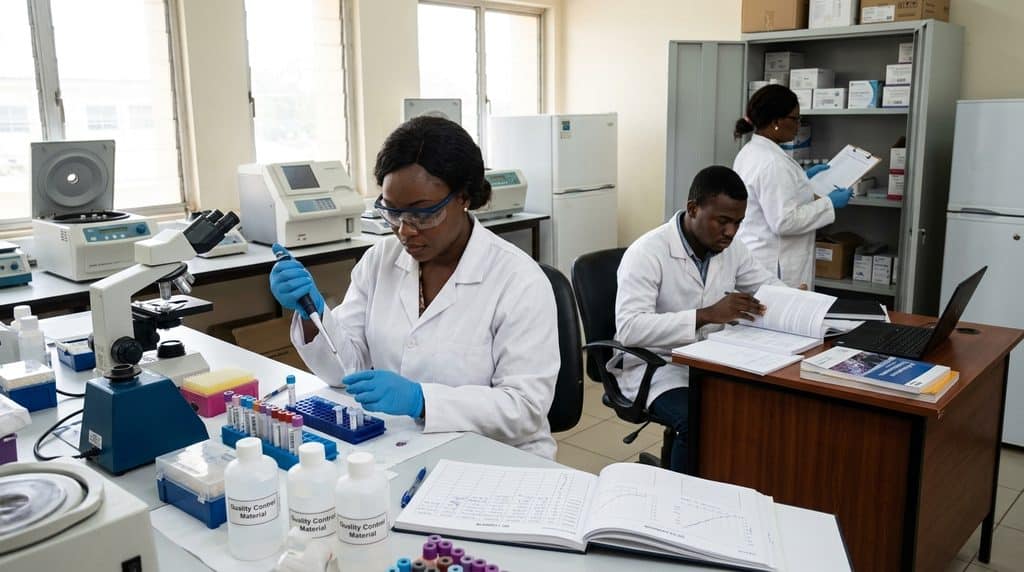
A 2026 needs assessment published in the Journal of Applied Laboratory Medicine gives one of the most current pictures of what laboratory professionals themselves report. The survey drew 121 responses from eight countries, with Zambia contributing the largest share, and was supported by interviews with laboratory professionals in Ethiopia, Ghana, Nigeria, and Zambia. Its authors note that the sample is small and self-selected, so the results are best read as a window into shared patterns rather than a continental census, but those patterns align closely with the wider literature.
Limited access to training and continuing education is among the most consistent findings. Fifty-eight percent of respondents reported lack of access to continuing education and 51 percent reported lack of access to training, and continuing education was identified as the primary need across every participating country. Interviewees described this as a barrier to lifelong learning that directly limits quality improvement, because laboratory scientists who cannot update their skills cannot reliably apply new methods or quality standards.
Funding and equipment shortfalls shape what the workforce can actually do. Two-thirds of respondents (66 percent) cited laboratory funding as a challenge, 60 percent cited lack of equipment, and 58 percent cited lack of quality control and external quality assessment materials. A trained scientist without reagents, working instruments, or quality control materials cannot produce dependable results, which is why workforce investment and infrastructure investment cannot be separated.
Staffing pressure and burnout compound the problem. In the same survey, 39 percent of respondents reported staff shortages, and interviewees linked inadequate staffing to high turnover and to burnout from high test volumes. When too few people carry too heavy a workload, experienced staff leave and the cycle of shortage repeats.
Weak professional recognition and regulation limit the profession’s ability to advocate for itself. About a quarter of respondents (26 percent) reported a lack of regulatory oversight, and one interviewee described a system in which laboratory medicine is not represented independently on national professional councils and is instead merged with other disciplines, leaving laboratorians without a meaningful voice. Interviewees also noted that, in some countries, nurses often collect specimens, which makes proper pre-analytical training essential. This invisibility is exactly what Bio-Reach’s work on making laboratory medicine visible seeks to change.
How Migration and Retention Compound the Problem
Training laboratory professionals is only half of the equation; keeping them is the other half. The WHO’s Health Workforce Support and Safeguards List identifies 55 countries with the most fragile health workforces, and WHO officials have reported that 37 of them are in the WHO African Region. The list is intended to discourage active international recruitment from these countries, but WHO has acknowledged that poor working conditions and low pay continue to push health workers to look abroad, and media reports on the 2023 update noted that African countries were among the hardest hit by outward migration.
Research on health worker migration generally focuses on doctors and nurses, but the same incentives apply to laboratory technologists and scientists, who hold portable qualifications and often face limited career pathways at home. WHO stresses that migration itself is not the problem when it is managed ethically and benefits both source and destination countries; the concern is unplanned loss from health systems that cannot replace the people they train. Policy options discussed in the literature include financial and technical support from destination countries, bilateral agreements, and building self-sufficient health systems that offer competitive careers locally.
Retention also depends on how the profession is perceived. When laboratory work is poorly understood by the public and by students, fewer young people enter it, and those who do may move into better-recognized health roles. That is why early exposure matters, a theme explored in introducing laboratory science to middle school students, and why every school should teach laboratory medicine.
What Is Working: Training, Leadership, and Regional Programs
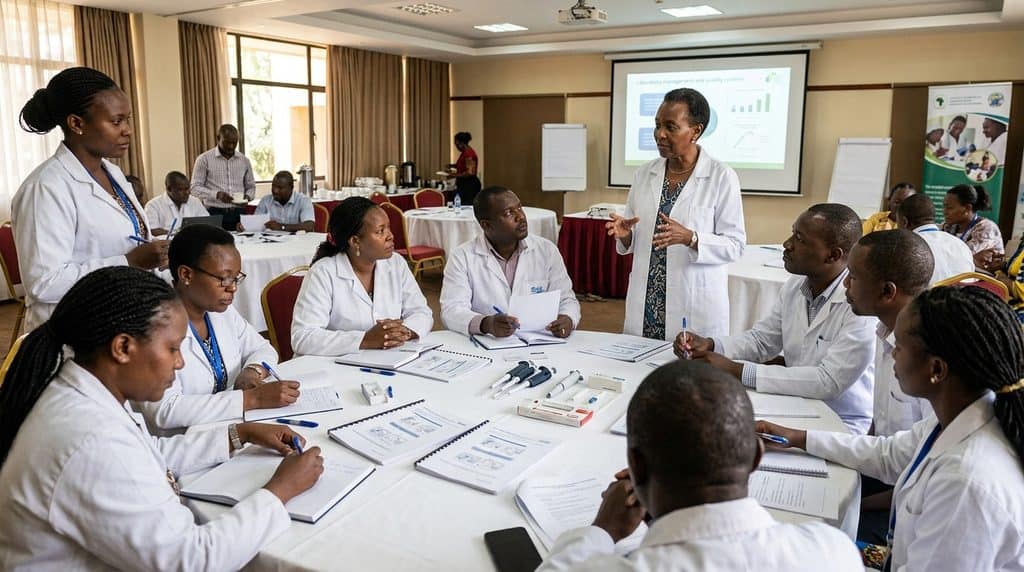
Despite the scale of the challenge, regional programs are building capacity in ways that suit local needs. Africa CDC convened the Africa Health Workforce Compact in 2025, focused on investment, training, and retention of a skilled health workforce, building on its 2020–2025 Framework for Health Workforce Development. Its Laboratory Leadership Program trained 34 laboratory professionals from 15 African Union member states in Lusaka in mid-2025, following earlier sessions in Nairobi, Addis Ababa, and Dakar, and its Africa Epidemic Services Laboratory Leadership Fellowship combines workshops, virtual learning, mentorship, and outbreak response assignments over 12 months. Applicants are expected to be employed in an African country with a commitment to return to their jobs after training, a design choice that directly addresses retention.
Specialist training is expanding as well. Africa CDC and the African Society for Laboratory Medicine run the Regional Training and Certification Program for Biosafety and Biosecurity Professionals, launched in 2022 to address shortages in specialized expertise. In 2026, the program added laboratory equipment maintenance and calibration, along with cyberbiosecurity and artificial intelligence, reflecting a recognition that a modern laboratory workforce needs technical and digital skills that traditional curricula often do not cover. These efforts complement the structured quality improvement work described in building sustainable laboratories in developing countries, where mentorship and training matter as much as equipment.
The survey evidence suggests that learning formats matter too. Respondents were nearly evenly split between preferring virtual and in-person education, which means that well-designed virtual continuing education can reach laboratory professionals who cannot travel for training, a practical opportunity for international and regional partners.
What Closing the Gap Requires
Closing the gap in laboratory workforce capacity will take sustained action on several fronts at once. Training pipelines need to produce enough graduates and keep them current, which means investing in educational institutions, continuing education, and mentorship rather than relying on short-term, project-based workshops. Bridging the gap between education and employment in laboratory science is part of this, because graduates need clear pathways into positions that exist and are funded.
Governments and funders need to treat the laboratory workforce as core health infrastructure. The 2026 survey’s interviewees noted that international donors have often prioritized communicable over non-communicable diseases, which constrains laboratory capacity just as non-communicable disease burdens are rising. Domestic budgets, competitive pay, and defined career ladders are essential to making laboratory careers sustainable.
Finally, the profession needs stronger recognition and representation. Independent regulation, certification, and professional councils give laboratory scientists a voice in national health planning, and community and institutional collaboration, as described in how community partnerships strengthen healthcare workforce development, helps connect training to real service needs.
Conclusion
Laboratory workforce challenges in Africa are not a single problem with a single fix. They are the product of limited training capacity, scarce funding and equipment, burnout and migration, and a profession that remains under-recognized relative to its role in every diagnosis. The WHO’s projection of a 6.1 million health worker shortfall by 2030 makes clear that the pressure will grow before it eases without deliberate investment.
The evidence also shows reason for cautious optimism. Leadership fellowships, regional certification programs, and virtual continuing education are expanding, and several are designed to keep skilled professionals working in their home countries. The work ahead is to scale what works, fund it domestically, and make laboratory careers visible, valued, and viable for the next generation.
FAQ
What are the main laboratory workforce challenges in Africa?
The main challenges are a shortage of trained laboratory professionals, limited access to training and continuing education, inadequate funding and equipment, staff burnout and turnover, health worker migration, and weak professional regulation and recognition. A 2026 survey of laboratory professionals in eight countries found funding (66 percent), equipment (60 percent), and continuing education (58 percent) among the most frequently reported problems.
How big is the health workforce shortage in Africa?
A WHO study of 47 countries found 1.55 physicians, nurses, and midwives per 1,000 people in the African Region, with only four countries surpassing the WHO benchmark. The WHO projects the regional shortage of health workers will reach 6.1 million by 2030, a 45 percent increase from the 2013 estimate.
Why do laboratory professionals leave their home countries?
WHO officials cite poor working conditions and low pay as key drivers of health worker migration, alongside limited career development opportunities. Laboratory professionals face the same pressures, and 37 of the 55 countries on the WHO safeguards list for health workforce recruitment are in the WHO African Region.
What is being done to strengthen Africa’s laboratory workforce?
Africa CDC has launched the Africa Health Workforce Compact and runs laboratory leadership training and fellowship programs, while Africa CDC and the African Society for Laboratory Medicine operate regional certification programs for biosafety and biosecurity professionals, expanded in 2026 to include equipment maintenance and calibration. Many of these programs require participants to commit to returning to their jobs, which supports retention.
How does the laboratory workforce shortage affect patients?
Fewer trained staff and fewer resources mean limited test menus, longer turnaround times, weaker quality control, and more samples sent to higher-level laboratories. Because laboratory results guide diagnosis and treatment, workforce gaps can lead to delayed or missed diagnoses, particularly in rural and underserved communities.
Bio-Reach is a non-profit organization dedicated to advancing Laboratory Medicine through advocacy, education, and global collaboration. To learn more or get involved, visit Bio-Reach