Every day, clinical laboratories around the world process millions of specimens, generate billions of data points, and deliver results that guide diagnoses, medications, and surgical decisions. The accuracy of those results is not guaranteed simply by having skilled staff and calibrated instruments. It depends on a structured, continuously monitored system to identify, assess, and control the risks embedded in every phase of the testing process. That system is laboratory risk management, and its effectiveness determines not only the quality of diagnostic output but the safety of every patient whose care depends on it.
In healthcare laboratories, risk is not a theoretical concept. It is the hemolyzed blood tube drawn through an active IV line. It is the culture plate stored two degrees outside its validated temperature range. It is the critical potassium value that sat in a queue for 90 minutes before a nurse was notified. Each of these scenarios represents a point in the total testing process where a failure can cascade into patient harm. Understanding those points, quantifying their likelihood and impact, and implementing controls to prevent or detect them is what laboratory risk management healthcare professionals are increasingly expected to do systematically.
This article examines what laboratory risk management means in a modern clinical context, where errors actually concentrate across the testing process, which frameworks laboratories use to structure their risk programs, and how the field is evolving in response to new pressures from automation, regulatory updates, and cybersecurity threats.
Where Errors Actually Occur: The Data Behind the Risk
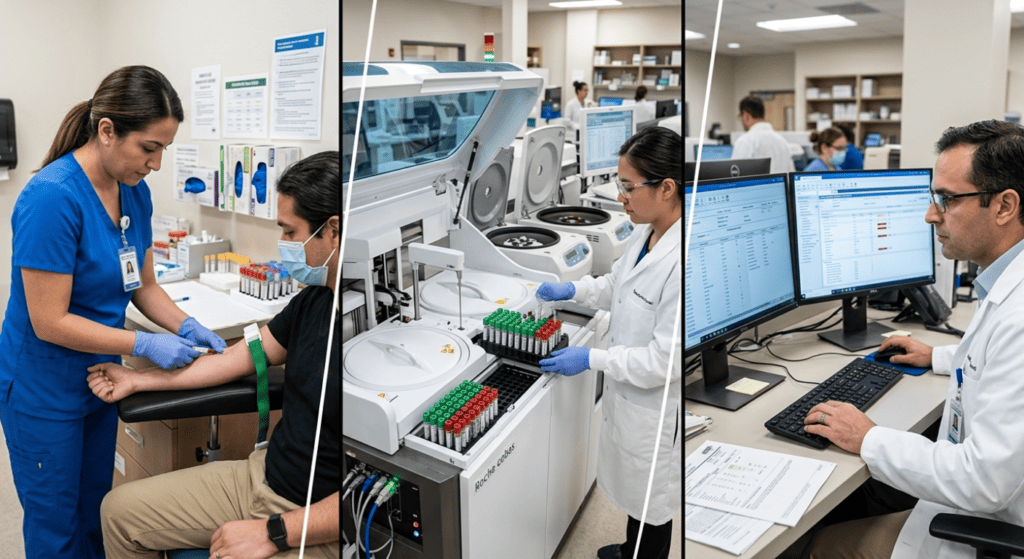
One of the most important shifts in laboratory quality science over the past two decades has been a clearer understanding of where errors actually originate. For much of the 20th century, quality control efforts in laboratories focused almost exclusively on the analytical phase, meaning the instrumentation, reagents, calibrators, and internal QC procedures that govern the measurement itself. This focus was understandable: the analytical phase is highly visible, largely automated, and relatively easy to monitor with statistical methods.
What research has consistently shown, however, is that the analytical phase is actually the least error-prone stage of the entire testing process. According to published literature including work by Plebani and Carraro that has been replicated across multiple settings, the pre-analytical phase accounts for between 46 and 68 percent of all errors in the total testing process. Post-analytical errors, encompassing result reporting, critical value communication, and clinician interpretation, account for an additional 18 to 47 percent. The analytical phase itself contributes only 7 to 13 percent of total errors.
These proportions have remained broadly stable even as overall error rates have declined significantly through automation and standardization. The implication is direct: laboratory risk management healthcare programs that focus only on analytical quality control are addressing a minority of the error burden. The greatest patient safety leverage lies in the phases surrounding the test itself.
Pre-analytical failures span a wide range of process steps. Wrong patient identification at the point of collection, specimen drawn through an infusion line that dilutes or contaminates the sample, inappropriate tube selection, inadequate sample volume, hemolysis caused by poor venipuncture technique, and delays in transport that degrade analytes sensitive to temperature or time are all documented sources of pre-analytical error. A study from a tertiary care hospital published in a peer-reviewed journal found that approximately 25 percent of all pre-analytical errors result in unnecessary follow-up investigations or inappropriate patient care, adding both financial burden and diagnostic delay. In anatomic pathology, a Wall Street Journal analysis cited by researchers found that three to five percent of biopsy specimens are defective in some way, whether through patient mix-up, insufficient tumor tissue, or contamination by extraneous cellular material.
Post-analytical failures, while less often discussed in laboratory QC literature, carry serious clinical consequences. Erroneous validation of results before release, delays in critical value notification, transcription errors when results are manually entered into a clinical record, and failure by clinicians to act on abnormal values all fall into this category. Diagnostic testing errors, across both laboratory and clinical phases, constitute the most prevalent category of medical malpractice claims in the United States, a pattern that underscores the cost of getting the process wrong at any stage.
The Risk Management Framework: From Identification to Control

Modern laboratory risk management does not operate through intuition or informal checklists. It operates through structured frameworks that provide reproducible methods for identifying what can go wrong, assessing how likely and how harmful each failure would be, and selecting controls proportionate to the risk.
The foundational tool in this process is the risk assessment. In clinical laboratory science, a risk assessment examines each step in the testing workflow and asks three questions: what could go wrong here, how often might it occur, and what would happen to the patient if it did. The answers to these questions are typically combined into a risk score that helps prioritize where to invest control resources. A failure that occurs rarely and causes only minor inconvenience is managed differently from one that occurs frequently and carries a potential for serious patient harm.
One structured approach to laboratory risk assessment is Failure Mode and Effects Analysis (FMEA), a method borrowed originally from aerospace and manufacturing engineering. In FMEA, each process step is analyzed for its potential failure modes, the causes of each failure, the effects on the patient or the process downstream, and the existing controls that might prevent or detect the failure before it reaches the patient. Each failure mode is then assigned scores for severity, occurrence probability, and detectability, which are multiplied into a Risk Priority Number (RPN) that guides remediation decisions. FMEA is recommended by the Clinical and Laboratory Standards Institute through its EP23 guideline on laboratory quality management and is increasingly expected by accrediting bodies as evidence of proactive risk thinking.
The 2022 revision of ISO 15189, the international standard specifying requirements for quality and competence in medical laboratories, introduced a more explicit and pervasive emphasis on risk-based thinking throughout the entire laboratory quality management system. Unlike its predecessor, the 2022 edition requires laboratories to document risk management not only for analytical processes but also for pre-examination and post-examination steps, governance of laboratory information, and management of point-of-care testing sites that fall under the laboratory’s authority. Laboratories seeking or maintaining ISO 15189 accreditation are now expected to demonstrate documented links between risk assessments, management reviews, and operational improvements, meaning risk management must be integrated into the governance structure of the laboratory rather than treated as a compliance exercise conducted at audit time.
Under the Clinical Laboratory Improvement Amendments (CLIA) in the United States, the Individualized Quality Control Plan (IQCP) framework provides a regulatory mechanism for laboratories to tailor their quality control programs based on documented risk assessments of their specific testing environment. An IQCP requires three components: a risk assessment that examines the specimen, test system, and testing personnel in context; a quality control plan built from those findings; and a quality assessment process to monitor whether the plan is working. The IQCP framework acknowledges what risk-based laboratory management already knows: a one-size-fits-all QC frequency is less effective than a program calibrated to the actual risk profile of a given test and setting.
High-Risk Zones in the Modern Clinical Laboratory

Certain areas of laboratory operations consistently surface as elevated risk zones that warrant targeted management strategies. Understanding these areas helps laboratory leaders allocate their risk control resources strategically.
Blood banking and transfusion medicine carry the highest potential for catastrophic patient harm of any laboratory discipline. A wrong-patient identification error in blood banking, where a unit of blood is crossmatched and released for a patient who is not its intended recipient, can cause an acute hemolytic transfusion reaction that is frequently fatal. The AABB and accrediting bodies require multiple independent patient identification checkpoints, two-sample policies before electronic crossmatch, and strict pre-transfusion verification procedures precisely because the consequence of failure in this domain is irreversible and can occur within minutes.
Microbiology presents a distinct risk profile centered on biosafety and on the time-sensitive nature of infectious disease reporting. Laboratories handling specimens from patients with suspected Mycobacterium tuberculosis, Category A bioterrorism agents such as Francisella tularensis, or emerging pathogens must operate within biosafety level frameworks aligned to the risk of aerosol exposure or inadvertent transmission. Risk management in this context extends beyond the patient to the laboratory worker and, in the case of communicable diseases, to the public.
Point-of-care testing (POCT) has expanded rapidly across inpatient units, emergency departments, and outpatient clinics. Because POCT devices are operated by nurses and other clinical staff rather than laboratory professionals, the risk profile differs substantially from central laboratory testing. Operator training variability, inconsistent quality control documentation, reagent storage in environments not optimized for laboratory materials, and connectivity gaps between POCT devices and laboratory information systems all create risk vectors that central laboratory testing does not share. A 2025 collective opinion published in laboratory medicine literature identified POCT as presenting additional pre-analytical error sources, including interference from whole blood matrix components that centralized testing handles through centrifugation, along with higher operator dependence and regulatory compliance challenges.
Molecular diagnostics and genomics represent an emerging risk zone as next-generation sequencing becomes part of routine oncology and infectious disease workups. The complexity of bioinformatics pipelines, the potential for sample cross-contamination during library preparation, the interpretive challenges of variants of uncertain significance, and the absence of universal result reporting standards all require tailored risk controls that most traditional laboratory quality programs were not designed to address.
Cybersecurity as a Laboratory Risk Category

One of the most significant expansions in the scope of laboratory risk management healthcare programs in recent years is the formal integration of cybersecurity risk. Laboratories that once managed risk primarily in biological, chemical, and process terms now operate within interconnected digital ecosystems where a network intrusion can compromise patient data, disrupt testing workflows, and delay care with consequences equivalent to a major equipment failure.
The scale of the threat is documented. In 2025, the first nine months of the year saw 293 ransomware attacks directed at hospitals, clinics, and direct care providers, along with an additional 130 attacks on laboratory vendors, revenue cycle management companies, and health IT providers. The 2024 Change Healthcare cybersecurity breach had, according to a KLAS research report, unprecedented ripple effects across the healthcare industry, disrupting claims processing and laboratory connectivity for weeks. For individual hospital laboratories whose LIS platforms or reference lab interfaces were affected, the impact manifested directly in delayed results and interrupted workflows.
Laboratory information systems, middleware platforms, and the interfaces between analyzers and LIS are all potential attack surfaces. Recovery from a ransomware attack in healthcare averaged $2.57 million in 2024, double the $1.27 million figure from 2021, and 37 percent of healthcare organizations took more than a month to fully recover. For a laboratory operating on a 24-hour, seven-day basis with time-critical reporting obligations, even a 24-hour outage represents a significant patient safety event.
ISO 15189:2022 addressed data and information management risk more explicitly than previous versions, requiring documented processes for protecting the integrity and confidentiality of laboratory information. Integrating cybersecurity risk assessment into the overall laboratory risk management program, rather than treating it as an IT department concern, is now a recognized best practice for laboratories seeking both accreditation and operational resilience.
Building a Culture of Risk Awareness

Documentation, frameworks, and regulatory compliance are necessary but not sufficient conditions for effective laboratory risk management. The evidence base in patient safety science, including foundational work from the Institute of Medicine, consistently identifies culture as the variable that determines whether formal safety systems produce sustained improvement or remain paper exercises. A laboratory where staff feel safe reporting a near-miss specimen labeling error, where process failures are investigated for systemic causes rather than individual blame, and where management visibly prioritizes safety over throughput will outperform one with equivalent written procedures but a punitive reporting environment.
Competency-based training plays a central role in embedding risk awareness at the bench level. Staff who understand not only how to perform a task correctly but why each step matters from a patient safety perspective are more likely to recognize deviations and report them. This is particularly relevant in the pre-analytical phase, where many of the highest-frequency errors occur outside the laboratory itself, performed by phlebotomists, nursing staff, or clinic personnel who may have no laboratory background. Extending risk management thinking into phlebotomy training, electronic order entry education for clinicians, and specimen transport protocol adherence is part of a comprehensive pre-analytical risk program.
Management review cycles that close the loop between identified risks, implemented controls, and observed outcomes complete the infrastructure of a functioning risk management system. ISO 15189:2022 places explicit emphasis on ensuring that management reviews are tied to operational data rather than conducted as formalities, and that action items from those reviews are tracked to completion. Laboratories heading into 2026 that invest in this traceability, from risk identification through control implementation through outcome verification, are better positioned to respond quickly when new failure modes emerge and to demonstrate the value of their quality programs to clinical leaders and accrediting bodies alike.
Conclusion
Laboratory risk management in healthcare is not a compliance function layered onto clinical operations; it is the structural foundation that makes clinical laboratory science reliable enough to influence 60 to 70 percent of all diagnostic decisions without systematic patient harm. The data are clear about where that risk lives: predominantly in the pre-analytical and post-analytical phases, not in the instrument room where quality control efforts have historically been concentrated. The frameworks exist to address it systematically, from FMEA and IQCP to ISO 15189:2022’s risk-based quality management requirements. The threat landscape has expanded to include cybersecurity alongside biological and process risk. And the cultural prerequisites for sustained improvement, psychological safety, transparent reporting, and management accountability, remain as important as any technical tool.
Investing in rigorous laboratory risk management is ultimately an investment in diagnostic accuracy, patient safety, and the professional credibility of laboratory medicine as a discipline. For any healthcare organization that depends on its laboratory, that investment is not optional.
Bio-Reach is a non-profit organization dedicated to promoting the essential role of Laboratory Medicine in healthcare. To learn more or get involved, visit bio-reach.org.