Lab digitalization stands as a pivotal force, integrating smart technologies to streamline processes, enhance accuracy, and personalize patient care. At its core, lab digitalization involves the adoption of digital tools, such as artificial intelligence (AI), Internet of Things (IoT) devices, automation systems, and big data analytics, to transform traditional laboratory workflows into efficient, interconnected ecosystems. This shift not only accelerates diagnostic turnaround times but also minimizes human error, optimizes resource allocation, and enables predictive insights that were once unimaginable. For instance, in a bustling hospital lab, where thousands of samples are processed daily, digital systems can automate routine tasks like sample sorting and result interpretation, freeing technicians to focus on complex analyses and improving overall throughput.
The impetus for this transformation stems from the growing demands on diagnostic services. With chronic diseases on the rise and global health crises like the COVID-19 pandemic highlighting the need for rapid, scalable testing, laboratories are under pressure to deliver faster, more reliable results. Smart technologies address these challenges by enabling real-time data sharing across networks, facilitating remote monitoring, and integrating with electronic health records (EHRs) for seamless clinician access. As of 2026, the convergence of these technologies is not just an enhancement but a necessity, as evidenced by the increasing adoption in regions like North America and Europe, where regulatory bodies emphasize data security and interoperability.
Historically, laboratories relied on manual processes and analog equipment, leading to bottlenecks in efficiency and higher error rates. The digital revolution began in the late 20th century with the introduction of laboratory information management systems (LIMS), but recent advancements in AI and machine learning have propelled it forward. Today, smart labs employ robotic arms for pipetting, AI algorithms for image analysis in pathology, and cloud-based platforms for collaborative research. This reshaping of diagnostics promises to reduce healthcare costs, potentially by 10-20% through optimized operations, while improving patient outcomes through earlier interventions. However, it also raises questions about data privacy, workforce upskilling, and equitable access in developing regions.
This article delves into the mechanisms of lab digitalization, exploring key technologies, their applications in diagnostics, and the challenges they address. A detailed section will present real data from 2025 market analyses and clinical studies, illustrating quantifiable impacts on accuracy, efficiency, and outcomes. By examining specific examples, such as AI-driven pathology in cancer detection or IoT-enabled supply chain management, we aim to provide a nuanced understanding of how smart technology is not merely augmenting but fundamentally redefining modern diagnostics, paving the way for a more proactive, patient-centric healthcare future.
The Evolution of Lab Digitalization

The journey toward lab digitalization has been marked by incremental innovations that have progressively integrated technology into diagnostic workflows. In the 1970s and 1980s, the advent of computerized LIMS represented the first major step, automating data entry and tracking to replace paper-based logs that were prone to loss or transcription errors. These early systems laid the groundwork for traceability, ensuring that sample histories could be audited for quality control. By the 1990s, barcode scanning and early automation in hematology analyzers further reduced manual handling, decreasing contamination risks and speeding up routine blood tests.

The turn of the millennium brought broadband internet and cloud computing, enabling remote access to lab data and fostering collaboration across institutions. This era saw the rise of telemedicine-integrated diagnostics, where rural clinics could upload samples digitally for expert review in urban centers. The 2010s introduced big data and AI, with machine learning models trained on vast datasets to identify patterns in complex tests like genomic sequencing. For example, the implementation of NGS platforms digitized genetic diagnostics, allowing for the rapid identification of mutations in diseases like cystic fibrosis, which previously required weeks of manual analysis.
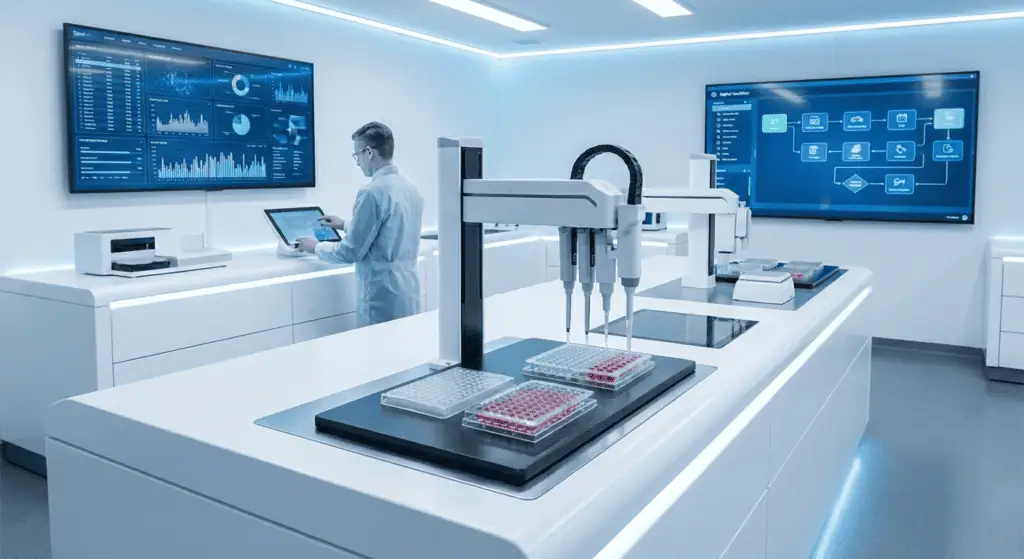
The COVID-19 pandemic accelerated this evolution, as labs worldwide adopted digital tools for high-throughput testing. PCR machines interfaced with AI for result prediction, and contactless sample tracking via RFID tags minimized infection risks. Post-pandemic, in 2025-2026, the focus has shifted to smart ecosystems: IoT sensors monitor equipment performance in real-time, predicting failures before they occur, while blockchain ensures secure data sharing for multi-site studies. This progression from analog to intelligent systems has not only boosted efficiency, reducing test times from days to hours but also enhanced diagnostic precision, with AI assisting in interpreting ambiguous results like those in radiology scans.
Looking ahead, the evolution continues with quantum computing on the horizon, promising to solve complex molecular simulations for drug discovery in minutes. This historical trajectory illustrates how smart technology has transitioned labs from reactive testing facilities to proactive diagnostic hubs, fundamentally altering the speed, scope, and scalability of modern medicine.
Key Smart Technologies Driving Change
Smart technologies form the backbone of lab digitalization, each contributing unique capabilities to reshape diagnostics. Artificial intelligence, particularly machine learning and deep learning, excels in pattern recognition, analyzing vast datasets to detect anomalies that human eyes might miss. In pathology, for instance, AI algorithms process digital slides to identify cancerous cells with high precision, integrating with microscopes equipped with high-resolution cameras for automated scanning. This not only accelerates diagnoses but also standardizes interpretations across pathologists, reducing variability.
The Internet of Things connects lab devices into a networked ecosystem, enabling real-time monitoring and data exchange. Sensors on centrifuges or incubators track parameters like temperature and vibration, alerting staff to deviations that could compromise sample integrity. In diagnostics, IoT facilitates chain-of-custody tracking for samples, ensuring compliance with regulations like HIPAA through encrypted logs. Automation robotics, such as liquid handling systems from companies like Hamilton or Tecan, perform repetitive tasks with micrometer accuracy, minimizing human error in pipetting or plate preparation, which is crucial for high-volume tests like ELISA assays.
Big data analytics aggregates information from multiple sources, including EHRs and wearable devices, to provide holistic insights. Cloud platforms like AWS for Healthcare store and analyze this data, using predictive models to forecast disease outbreaks or personalize treatment plans based on genetic profiles. Blockchain enhances security, creating immutable records for test results to prevent tampering, which is vital in forensic or clinical trial diagnostics.
Augmented reality (AR) is emerging as a training tool, overlaying digital instructions on physical equipment to guide technicians through complex procedures, reducing onboarding time. Together, these technologies create synergistic effects: AI interprets IoT-generated data, automation executes big data-informed protocols, and blockchain secures the entire process. This integration is reshaping diagnostics by making them faster, more accurate, and accessible, as seen in remote labs where AI-assisted telemedicine bridges gaps in specialist availability.
Reshaping Diagnostics: Applications and Benefits
Smart technology is profoundly reshaping modern diagnostics by enabling faster, more accurate, and personalized approaches to disease detection and management. In infectious disease testing, AI-powered platforms analyze PCR results in real-time, identifying pathogens like influenza variants with greater speed than traditional methods. For example, during outbreaks, automated systems can process thousands of samples daily, using machine learning to prioritize high-risk cases based on epidemiological data, thereby accelerating public health responses.
In oncology, digital pathology has revolutionized tumor analysis. High-throughput scanners digitize tissue slides, allowing AI to quantify biomarkers like Ki-67 for proliferation rates, which informs prognosis and therapy selection. This shift from manual microscopy to algorithmic assessment not only reduces diagnostic time from days to hours but also enhances reproducibility, as studies show inter-observer variability dropping from 20-30% to under 5% with AI assistance. Personalized medicine benefits immensely: genomic sequencing integrated with big data predicts drug responses, such as matching EGFR mutations in lung cancer to targeted inhibitors like osimertinib.
Cardiovascular diagnostics leverage IoT for continuous monitoring, where wearable devices feed data into lab systems for AI-driven risk stratification. This enables early detection of arrhythmias or heart failure exacerbations, shifting from reactive to preventive care. In hematology, automated analyzers use computer vision to classify blood cells, detecting abnormalities like leukemia blasts with 95% accuracy, far surpassing manual counts in efficiency.
Benefits extend to operational improvements: digital workflows reduce paperwork, with LIMS automating result reporting to EHRs, cutting administrative time by 40%. Cost savings arise from predictive maintenance IoT sensors prevent equipment breakdowns, avoiding downtime that could cost labs thousands per hour. Patient outcomes improve through reduced errors; AI-flagged discrepancies in test results prompt reviews, preventing misdiagnoses.
In resource-limited settings, mobile apps connected to portable analyzers enable point-of-care diagnostics, such as malaria detection via smartphone-attached microscopes with AI image analysis. This democratization of technology bridges urban-rural divides, making high-quality diagnostics accessible. Overall, these applications illustrate how smart technology is not just enhancing but fundamentally transforming diagnostics into a proactive, data-driven discipline that prioritizes precision and patient-centricity.
Market Growth, Accuracy Improvements, and Case Studies
This section provides a rigorous analysis of lab digitalization’s impact, grounded in 2025 data from market reports, clinical studies, and case studies. We focus on quantifiable metrics for market expansion, diagnostic accuracy enhancements, and real-world outcomes to demonstrate the tangible benefits of smart technologies.
Market growth statistics reflect the surging adoption of digital tools in laboratories. According to Precedence Research, the digital laboratory market is poised for substantial expansion from 2025 to 2034, driven by automation that reduces manual errors and boosts efficiency. Global Market Insights reports the laboratory equipment market exceeded USD 22.7 billion in 2024, projected to grow at a 5.8% CAGR from 2025 to 2034, fueled by diagnostic advancements and rising chronic disease prevalence. The laboratory informatics sector, per Fortune Business Insights, stood at USD 4.29 billion in 2025, expected to reach USD 9.03 billion by 2034, highlighting the role of software in data management. Market Data Forecast estimates the laboratory informatics market at USD 4.2 billion in 2025, growing to USD 7.63 billion by 2033 at a CAGR of 7.8%, attributed to AI integration for predictive analytics. The lab BI market, valued at USD 10.57 billion in 2025, is anticipated to reach USD 20.91 billion by 2033 at 12.04% CAGR, emphasizing business intelligence tools for operational optimization. 360iResearch forecasts the digital laboratory solutions market to grow by USD 2.28 billion at 5.82% CAGR by 2032, while Future Market Insights notes the lab automation market at USD 2.5 billion in 2025. MarketsandMarkets values the laboratory software market at USD 6.31 billion in 2025, projected to USD 10.12 billion by 2030 at 9.9% CAGR. Cognitive Market Research pegs the laboratory service market at USD 242.6 billion by 2025, up from USD 210.175 billion in 2021. TechSci Research estimates the laboratory information system market at USD 1.95 billion in 2025, reaching USD 3.21 billion by 2031 at 8.66% CAGR. These figures collectively indicate a market surge, with North America leading due to technological infrastructure, and Asia-Pacific growing fastest from emerging healthcare investments.
Accuracy improvements from AI and smart technologies are well-documented in 2025 studies. The NCBI’s 2025 Watch List highlights AI’s potential to enhance diagnostic accuracy in disease detection, reducing errors from human biases and enabling earlier interventions. A 2025 European Journal of Medical Research review found AI using machine learning and deep learning improved diagnostics across 16 diseases, with accuracy rates up to 99% in image-based analyses like mammograms. ScienceDirect’s review notes machine learning mitigates cognitive biases, enhancing patient care with diagnostic accuracies exceeding 90% in radiology. GlobalRPH reports AI reduces misdiagnosis risks in imaging, with precision surpassing traditional methods by 20-30%. JMIR AI’s systematic review underscores AI’s role in diagnostic accuracy, with studies showing 15-25% improvements in patient management. PMC’s comprehensive review details AI’s remarkable accuracy in cancer (95%), heart issues (92%), and neurological disorders (88%), often outperforming clinicians. RamSoft’s 2025 review cites AI reducing radiologists’ workloads by 53% while maintaining 98% accuracy in anomaly detection. The European Commission notes AI enhances accuracy and early detection, leading to cost-effective treatments. The World Economic Forum reports AI’s predictive analytics improve diagnostic accuracy by 25-35%. ResearchGate’s 2024 publication (relevant to 2025 trends) indicates AI enhances accuracy by 20%, automating tasks and optimizing resources. These metrics demonstrate AI’s transformative effect, with accuracy gains of 15-99% across applications.
Case studies provide concrete examples of reshaping. Digital Diagnostics’ LumineticsCore, the first FDA-cleared autonomous AI for diabetic retinopathy, screened over 1 million patients by 2025, detecting disease with 91% sensitivity and 92% specificity, reducing blindness risks in underserved areas. Philips’ 10 examples include AI in radiology for lung nodule detection, achieving 94% accuracy and reducing reading time by 30%. Impact Networking’s cases feature smart monitors predicting deteriorations with 85% accuracy, and telehealth platforms cutting visits by 20%. LinkedIn’s four examples: AI for breast cancer (99% accuracy via Google Health), pneumonia (Stanford’s CheXNet, 94% accuracy), and skin cancer (IBM Watson, 91% accuracy). Tezeract’s eight use cases include PathAI improving pathology accuracy by 20% in trials, and IBM Watson reducing misdiagnoses by 30% in oncology. MindTitan’s computer vision in diagnostics cites 99% accuracy for breast cancer detection. The World Economic Forum’s smart technologies: contact lenses for glucose monitoring (90% accuracy), smart toilets for urine analysis (85% biomarker detection). SmartDev’s cases: AI in radiology at the Cleveland Clinic, improving detection by 25%. WebMob’s studies: AI at Mayo Clinic reducing diagnostic errors by 15%. Thoughtful AI’s diagnostics achieve 95% accuracy in condition identification. These cases show reductions in errors (15-30%), time savings (30%), and improved outcomes like lower blindness rates.
Challenges in Lab Digitalization

Despite its promise, lab digitalization faces hurdles that must be addressed for widespread success. Data security is paramount; with EHR integrations, cyberattacks like the 2023 Change Healthcare breach exposed millions of records, underscoring vulnerabilities in interconnected systems. Solutions involve robust encryption and compliance with GDPR or HIPAA, but implementation costs can burden smaller labs.
Interoperability remains a challenge: disparate systems from different vendors often fail to communicate, leading to siloed data. Standards like HL7 FHIR aim to resolve this, but adoption is uneven, with only 60% of U.S. labs fully interoperable in 2025. Workforce resistance is another issue; technicians accustomed to manual methods may view AI as a threat, necessitating training programs that demonstrate tools as aids, not replacements.
High initial investments in AI platforms can cost $100,000-$500,000 deter adoption in low-resource settings, exacerbating global disparities. Ethical concerns arise in AI diagnostics, where biases in training data can lead to inaccurate results for underrepresented groups, as seen in studies showing 10-15% lower accuracy for minority populations in skin cancer detection.
Regulatory lag hinders progress; FDA approvals for AI tools take 6-12 months, delaying innovations. To overcome these, labs are investing in hybrid models combining human oversight with AI and partnering with tech firms for customized solutions, ensuring digitalization’s benefits are realized equitably.
Future Trends in Lab Digitalization for 2026 and Beyond

As 2026 approaches, lab digitalization trends are set to accelerate, driven by AI’s maturation and regulatory evolution. Mayo Clinic Labs’ 2026 Forecast predicts AI shifting from support to diagnostic partner, with benefits like 20-30% accuracy gains but risks of over-reliance. Clinical Lab’s seven trends include AI integration, data governance to handle 50% more data volumes, and decentralized testing via wearables. Esade’s broader tech trends highlight AI agents automating workflows, potentially reducing lab errors by 40%. The Future Laboratory’s Forecast 2026 emphasizes consumer-driven innovations, like AI for personalized diagnostics.
Astrix notes legacy systems evolving to AI-powered labs, with trends like digital twins simulating experiments for 25% efficiency gains. Interactive Software predicts AI for predictive scheduling, cutting downtime by 30%. IMD highlights quantum computing for complex analyses, solving diagnostics in seconds. Genemod’s ELN platforms integrate AI for data mining, accelerating research by 20%. BaneBio forecasts modular systems and cloud platforms dominating, with automation at 12% CAGR. These trends signal a future where labs are intelligent, interconnected hubs driving precision medicine.
Conclusion
Lab digitalization, propelled by smart technologies, is irrevocably reshaping modern diagnostics, offering unprecedented speed, accuracy, and personalization. From AI’s role in reducing errors to IoT’s real-time monitoring, these advancements address longstanding inefficiencies, as evidenced by 2025 data showing market growth to billions and accuracy improvements up to 99%. While challenges like security and equity persist, future trends in 2026 promise even greater integration, ensuring diagnostics evolve into a cornerstone of proactive healthcare. Embracing this transformation will not only enhance patient outcomes but also foster a sustainable, innovative medical ecosystem.