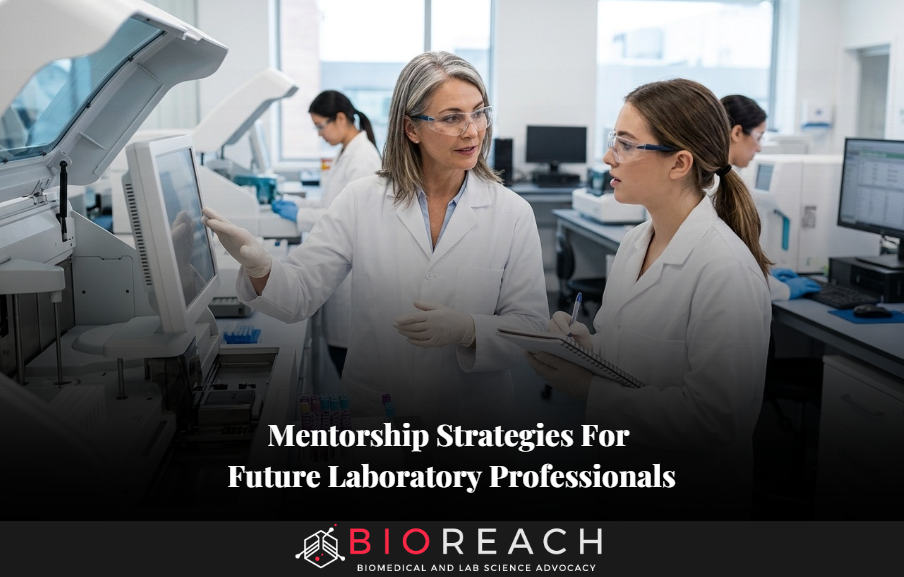
Laboratory mentorship works best when it is structured, starts before graduation, and pairs new professionals with experienced colleagues who can explain workplace culture as well as technical tasks. Direct evidence on mentorship in laboratory medicine is thin, but a 2025 umbrella review of 13 reviews on mentoring newly graduated nurses found one-year retention of 72 to 100 percent and post-program turnover of 3.5 to 20 percent, compared with up to 50 percent before the programs began. For a profession facing workforce shortages, deliberate mentorship is one of the lower-cost ways to help new professionals stay.
Laboratory professionals rarely appear in public descriptions of healthcare, which means that students and new graduates often learn what the work is really like only after they start. A good mentor closes that gap by explaining the unwritten parts of the job, from off-shift routines to how a result is escalated, and by showing what a long career in the laboratory can look like. This article looks at why laboratory mentorship matters, what the research does and does not show, how structured programs are built, what mentors and mentees each need to do, and how organizations can sustain mentorship over time.
Why Laboratory Mentorship Matters Now
Laboratories are competing for a limited pool of new professionals while experienced staff approach retirement, a pressure explored in the economic impact of laboratory workforce shortages. Recruiting is only half of the problem. A new graduate who leaves within a few years takes the cost of training with them, and the laboratory starts again.
Early research on laboratory professionals suggests that what keeps people in the field is not only pay. In a 2007 study published in the journal of the American Society for Clinical Laboratory Science, Susan Beck and Kathy Doig surveyed new clinical laboratory scientists and found that interesting work, good salaries, and advancement opportunities were the factors most important for staying in the profession. Respondents whose expectations at career entry best matched their actual jobs were the most satisfied and planned to stay the longest.
That finding is relevant to mentorship, because setting realistic expectations is one of the things a mentor does best. The study is nearly two decades old, and only its abstract was available to me, so it should be read as a useful signal rather than a current measurement. Mentorship also supports the broader goal of building a profession that new people can see themselves in, which connects to building a diverse laboratory workforce for the future. People are more likely to pursue and remain in a career when they can name someone who has done it.
What the Evidence Shows, and What It Does Not

It is worth being clear about the limits of the evidence. I did not find a controlled study that measures the effect of a formal mentorship program on retention among laboratory professionals specifically. What exists in laboratory science is mostly descriptive research and recommendations.
A 2017 pilot study by Janna Schill of the University of North Dakota, published in the same society’s journal, examined the professional socialization of early career medical laboratory scientists using surveys and online focus groups from a single accredited program. It did not measure mentorship directly. It did recommend that employers pair new graduates with experienced scientists, with the mentoring focused on workplace culture, such as managing off-shift schedules, work-life balance, and relationships with colleagues, rather than on specific job tasks. The author supported the idea with evidence from nursing, and the study’s small, single-program sample limits how far its conclusions can be generalized.
The nursing evidence is the strongest nearby comparison. An umbrella review by Södergård and colleagues, published in the Journal of Advanced Nursing in 2025, synthesized 13 systematic and integrative reviews of mentoring programs for newly graduated nurses. Programs fell into three groups: didactic, interaction-based, and combined. Retention ranged from 72 to 100 percent at one year and 70 to 98 percent at two years, and turnover after the programs ranged from 3.5 to 20 percent compared with up to 50 percent before. Several studies reported statistically significant gains, particularly where structured education was combined with preceptorship, and the authors concluded that ongoing support and structured guidance increase retention and reduce turnover.
Nursing is a different profession with different working conditions, so these figures cannot be assumed to transfer to the laboratory. They do offer a reasonable hypothesis: structured, sustained support for new graduates is associated with better retention, and laboratories can test that locally by tracking their own turnover before and after a program.
Designing a Structured Mentorship Program

The nursing review’s most consistent signal is that structure matters. Informal goodwill helps, but a program with defined pairings, expectations, and time commitments is easier to sustain and to evaluate. A workable laboratory program can be built from a few components.
The first is thoughtful matching. Pairing by shift, discipline, and career interest is more useful than pairing by availability alone, because the mentor can only advise on situations they understand. A new microbiology technologist benefits most from someone who has worked a microbiology bench, though a mentor from another section can still add perspective on professional development.
The second is a clear focus. Following the recommendation in Schill’s study, the first conversations should address workplace culture and daily realities, including off-shift schedules, how to ask for help during a busy shift, how to handle a mistake or a near miss, and how to build relationships across the laboratory. Technical competency is assessed through the laboratory’s training and competency programs, and mentorship works alongside them rather than replacing them.
The third is a defined timeline. A year-long arrangement, with regular meetings scheduled in advance, gives the relationship time to move from orientation to career planning. Short, informal check-ins in the first weeks, followed by a monthly conversation, are easier to sustain than occasional long meetings that are easily postponed.
The fourth is a way to measure results. A laboratory that records retention, new-hire satisfaction, and time to independent work before and after a program can judge whether it is working and can adjust. Because published laboratory-specific data are limited, local measurement also contributes to the evidence base.
Mentorship Before the First Job
Mentorship does not have to wait for employment. Students decide which careers to pursue long before they reach a clinical rotation, and many never hear about laboratory medicine at all. Programs that introduce the work early, such as those described in introducing laboratory science to middle school students and why every school should teach laboratory medicine, give practicing professionals a natural role as guides.
For students already in a laboratory program, mentors can help bridge the gap between education and employment, a challenge discussed in bridging the gap between education and employment in laboratory science. A mentor can explain what employers look for, how to prepare for an interview, and what to expect from the first year. This kind of guidance is valuable precisely because the profession is so little known. As creating awareness for healthcare’s hidden profession argues, many people simply do not know the field exists, so a mentor is often the first person to make it visible.
What Makes a Good Mentor and a Good Mentee

Good mentors are usually generous with time and honest about their own path, including the difficult parts. They listen before advising, share what they wish they had known, and introduce mentees to people who can open doors, whether that is a colleague in another discipline or a professional society. They also recognize the limits of their role. Mentors do not evaluate performance on behalf of the employer, and keeping that boundary clear helps mentees speak candidly.
Mentees get the most from the relationship when they come prepared. That means bringing specific questions, taking responsibility for scheduling, and acting on the advice they receive. They should also feel free to seek more than one mentor, since different people can help with technical growth, leadership development, and balancing work and life.
Both sides benefit from a shared understanding of the goals at the outset. Writing down a few simple objectives, such as completing a certification, learning a new discipline, or preparing for a supervisory role, gives the relationship direction and a point to review after six months.
Sustaining Mentorship Across a Career

Mentorship is often described as something for new graduates, but its value extends across a career. Experienced professionals moving into supervision, or from the bench into education, benefit from guidance just as new graduates do. Organizations that treat mentoring as a continuing part of professional development, rather than a one-time onboarding step, build a culture in which knowledge is passed on deliberately.
Professional societies and community partnerships can extend the reach of individual laboratories, especially for smaller facilities that have few experienced staff to spare. The partnerships described in how community partnerships strengthen healthcare workforce development offer a model, linking laboratories, schools, and community organizations so that mentors and learners can find one another. Recognizing mentors, by counting the time they spend toward professional development or acknowledging it in performance reviews, also keeps the practice from becoming an unpaid burden on a few dedicated people.
Conclusion
Laboratory mentorship is a practical, low-cost way to help new professionals understand the profession, build confidence, and decide to stay. The strongest evidence comes from nursing rather than laboratory science, and honesty about that gap matters, but the research on laboratory professionals consistently points to expectations, workplace culture, and advancement as the factors that shape whether people remain. A structured program addresses all three.
The next step is to make mentorship routine rather than occasional: define pairings, set a timeline, focus on the realities of the job, and measure outcomes. Laboratories, educators, and professional organizations that invest in the next generation now will be better placed to meet the workforce challenges ahead.
Frequently Asked Questions
What is laboratory mentorship?
Laboratory mentorship is a relationship in which an experienced laboratory professional guides a student or early-career colleague. It covers workplace culture, career planning, and professional confidence as well as technical skills, and it works alongside formal training and competency assessment rather than replacing them.
Does mentorship improve retention in laboratory medicine?
There is no controlled study that directly measures this in laboratory professionals. Research on early-career medical laboratory scientists recommends mentorship, and a 2025 umbrella review of 13 reviews on newly graduated nurses found one-year retention of 72 to 100 percent in mentoring programs and post-program turnover of 3.5 to 20 percent. Those nursing results are suggestive rather than proof for laboratories.
What should a mentor focus on with a new graduate?
Research on early career laboratory scientists suggests focusing on workplace culture rather than specific job tasks. That includes off-shift schedules, work-life balance, how to ask for help, and building relationships with colleagues, while technical competency is handled through the laboratory’s training program.
How long should a mentorship program last?
A year-long structure is common in the nursing programs that have been studied, with frequent contact early on and regularly scheduled meetings afterward. The right length depends on the laboratory, but a defined timeline helps both mentor and mentee commit.
Can students find a laboratory mentor before they graduate?
Yes. Students can ask program faculty, clinical rotation preceptors, and professional societies for introductions, and laboratories can invite students to shadow staff. Early contact helps students understand a profession that is often invisible to the public and prepares them for the transition to work.
Bio-Reach is a non-profit organization dedicated to advancing Laboratory Medicine through advocacy, education, and global collaboration. To learn more or get involved, visit bio-reach.org.