The clinical laboratory workforce sits at the center of modern healthcare, generating the data behind the great majority of medical decisions. Yet the professionals who do this work do not fully reflect the diversity of the patients they serve. This gap is not merely a matter of fairness in hiring, though it is that. A workforce that does not mirror its patient population has measurable consequences for the quality and equity of diagnostic care, and closing the gap is both a moral imperative and a practical necessity for a profession facing a severe and worsening shortage.
Building a diverse laboratory workforce means intentionally expanding access to laboratory science careers for people of all racial, ethnic, socioeconomic, and geographic backgrounds, and creating environments where they can enter, advance, and stay. It is closely tied to the field’s larger workforce crisis: the same barriers that keep the profession invisible to underrepresented communities also shrink the overall talent pipeline. Addressing diversity and addressing the shortage are, to a significant degree, the same project.
This article examines why representation in laboratory medicine matters, the barriers that have kept the workforce less diverse than it should be, and the strategies that can build a laboratory workforce reflecting the full range of the population it serves.
Why Representation Matters in the Laboratory

It is tempting to assume that because laboratory professionals rarely interact directly with patients, workforce diversity matters less in laboratory medicine than in patient-facing fields. This assumption is wrong, and understanding why reveals how consequential representation actually is.
The most direct reason is diagnostic accuracy across populations. Reference intervals, the ranges against which laboratory results are judged normal or abnormal, and the diagnostic algorithms built on them, are derived from reference populations. When those populations are not representative of all the patients a test will be applied to, the resulting reference ranges can produce misleading results for underrepresented groups. A diverse laboratory workforce is better positioned to recognize when a reference interval or diagnostic algorithm may not fit the patient in front of it, and to advocate for the corrections that make testing equitable. As artificial intelligence enters diagnostic workflows, this vigilance becomes even more important, because algorithms trained on non-representative data can encode and amplify existing biases in ways that a homogeneous workforce may not notice.
A second reason is the well-documented link between healthcare workforce diversity and outcomes for underserved patients. Research across healthcare consistently shows that a diverse workforce improves care for marginalized populations through better communication, community trust, and reduced implicit bias. In laboratory medicine, this manifests in the design of testing services, the interpretation of results in cultural and clinical context, and the responsiveness of laboratory leadership to the needs of diverse communities.
A third reason is talent. The laboratory workforce shortage is severe, with the United States and Canada short an estimated tens of thousands of professionals and graduation rates producing less than half the number needed. A profession that fails to recruit from the full diversity of the population is voluntarily ignoring a large share of potential talent. Every capable student from an underrepresented community who never learns the field exists is a loss the profession cannot afford. Diversity efforts and pipeline-building efforts are, in this sense, inseparable.
The Barriers That Limit Diversity
If the case for a diverse laboratory workforce is clear, the barriers to achieving it are equally identifiable. Several structural factors have kept the profession less representative than it should be.
The foremost barrier is visibility, and it falls unevenly. Laboratory medicine is invisible to most students as a career option, but it is most invisible to students from communities that lack family connections or informal networks in healthcare. A student whose relatives work in medicine may hear about laboratory careers at the dinner table; a first-generation student from an underserved community is far less likely to encounter the field at all. Because the profession is not promoted in schools and is unknown to many guidance counselors, the students least likely to discover it are precisely those from underrepresented backgrounds. This is one of the strongest arguments for bringing laboratory medicine into schools that serve these communities.
Financial barriers compound the visibility problem. Laboratory science education requires specialized coursework, clinical rotations, and certification, all of which carry costs. For students from lower-income backgrounds, the combination of tuition, the opportunity cost of unpaid clinical placements, and the absence of scholarships targeted at laboratory science can make the path prohibitive even when the interest exists.
Geographic distribution creates further inequity. Accredited laboratory science programs are unevenly distributed, and their numbers have declined over the past decade. Students in regions without a nearby program face relocation costs or the impossibility of attending at all, a barrier that disproportionately affects rural and lower-income communities.
Retention challenges affect diversity as well as overall numbers. Recruiting professionals from underrepresented backgrounds into the field is only half the task; keeping them requires workplace environments where they can advance and feel valued. The profession’s historically limited career ladder, compensation that has lagged comparable healthcare roles, and, for some, workplace environments not designed with them in mind all contribute to attrition that can fall hardest on those already underrepresented.
Strategies for Building a Diverse Workforce

The barriers are real, but so are the strategies for overcoming them. Building a diverse laboratory workforce requires coordinated effort across education, finance, mentorship, and workplace culture.
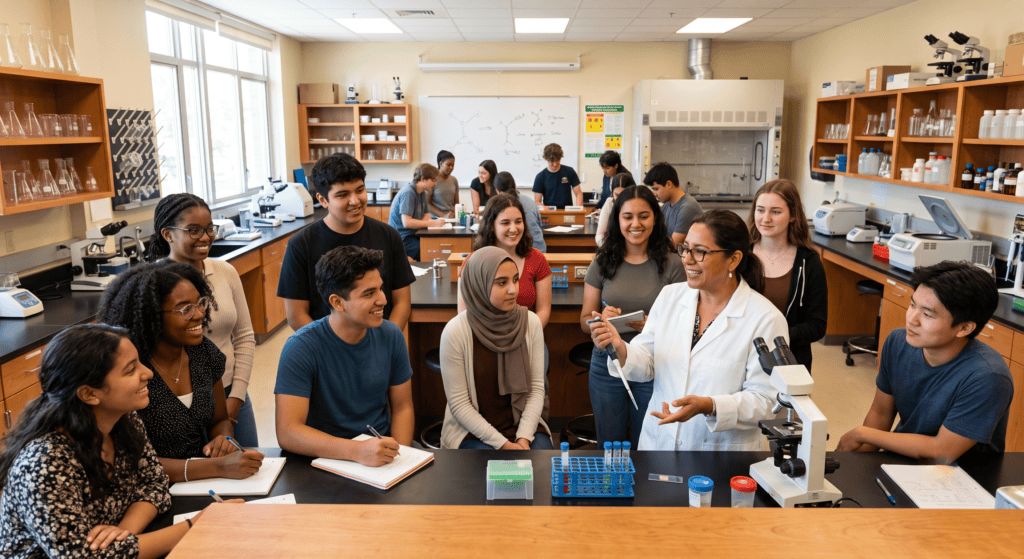
Early and targeted outreach is the foundation. Because the pipeline problem begins with awareness, the most effective diversity strategies bring laboratory medicine directly to students in underrepresented communities, through classroom demonstrations, career fairs, phlebotomy programs, and hands-on immersion experiences. Reaching students in middle and high school, before career paths narrow, and equipping their teachers and counselors with knowledge of the field, opens doors that would otherwise stay closed. Programs specifically designed to serve historically underrepresented communities, like Bio-Reach’s Lab Lit initiative, are built precisely on this insight.
Scholarship and financial support directly address the cost barrier. Targeted scholarships, paid internships and clinical placements, and loan repayment programs for laboratory professionals remove the financial obstacles that keep talented students from lower-income backgrounds out of the field. Legislative efforts to establish loan repayment and training grants for laboratory personnel, if enacted, would disproportionately benefit students for whom cost is the deciding factor.
Mentorship networks help both recruitment and retention. Early-career professionals from underrepresented backgrounds benefit enormously from mentors who can help them navigate academic programs, certification, and workplace environments. Mentorship also builds the sense of belonging that keeps professionals in the field, and it creates role models whose visible success shows the next generation of students that the profession is open to them.
Expanding and diversifying training access matters structurally. Growing the number of accredited programs, particularly at community colleges and in underserved regions, and using hybrid and online coursework paired with regional clinical rotation networks, can broaden access for students who cannot relocate. Recognizing internationally educated laboratory professionals through credentialing pathways also expands and diversifies the talent pool with experienced practitioners.
Finally, workplace culture and career advancement must support retention. Building genuine career ladders that recognize specialization and leadership, advocating for pay equity and professional development, and creating inclusive environments where all professionals can thrive are essential to keeping a diverse workforce, not just recruiting one. Bio-Reach’s work championing diversity and inclusion in the clinical laboratory workforce reflects this comprehensive understanding: representation is built not through a single intervention but through sustained attention across the entire career arc.
Diversity and Global Health Equity
The case for a diverse laboratory workforce extends beyond any single country. Globally, the distribution of laboratory capacity is profoundly uneven, with many low- and middle-income regions lacking the diagnostic infrastructure and trained professionals that reliable healthcare requires. Building laboratory capacity in these settings, training local professionals, supporting local institutions, and investing in local pipelines, is both a diversity effort and a health equity effort on a global scale.
A world in which misdiagnosis is not a leading cause of death and reliable laboratory medicine is accessible to everyone, the vision that drives Bio-Reach’s mission, cannot be achieved by a workforce concentrated in wealthy regions and drawn from narrow demographics. It requires investment in laboratory professionals everywhere, drawn from the communities they serve. The diversity of the laboratory workforce, in this broader sense, is inseparable from the global accessibility of trustworthy diagnosis.
Conclusion
A diverse laboratory workforce is not a peripheral goal to be pursued after the shortage is solved. It is central to solving the shortage, and central to the quality and equity of diagnostic care. Representation in laboratory medicine improves diagnostic accuracy across populations, strengthens outcomes for underserved patients, guards against bias in an increasingly algorithm-assisted field, and expands the talent pool a shorthanded profession desperately needs.
The barriers, invisibility, cost, geography, and retention, are well understood, and so are the solutions: early and targeted outreach, financial support, mentorship, expanded training access, and inclusive workplace cultures. What is required is the sustained commitment to implement them, from educational institutions, employers, professional organizations, and advocacy groups alike. The laboratory workforce of the future should reflect the full diversity of the patients it serves, not only because it is right, but because trustworthy, equitable diagnosis depends on it. Building that workforce is one of the most important investments the profession can make.
Bio-Reach is a non-profit organization dedicated to advancing Laboratory Medicine through advocacy, education, and global collaboration. To learn more or get involved, visit bio-reach.org.