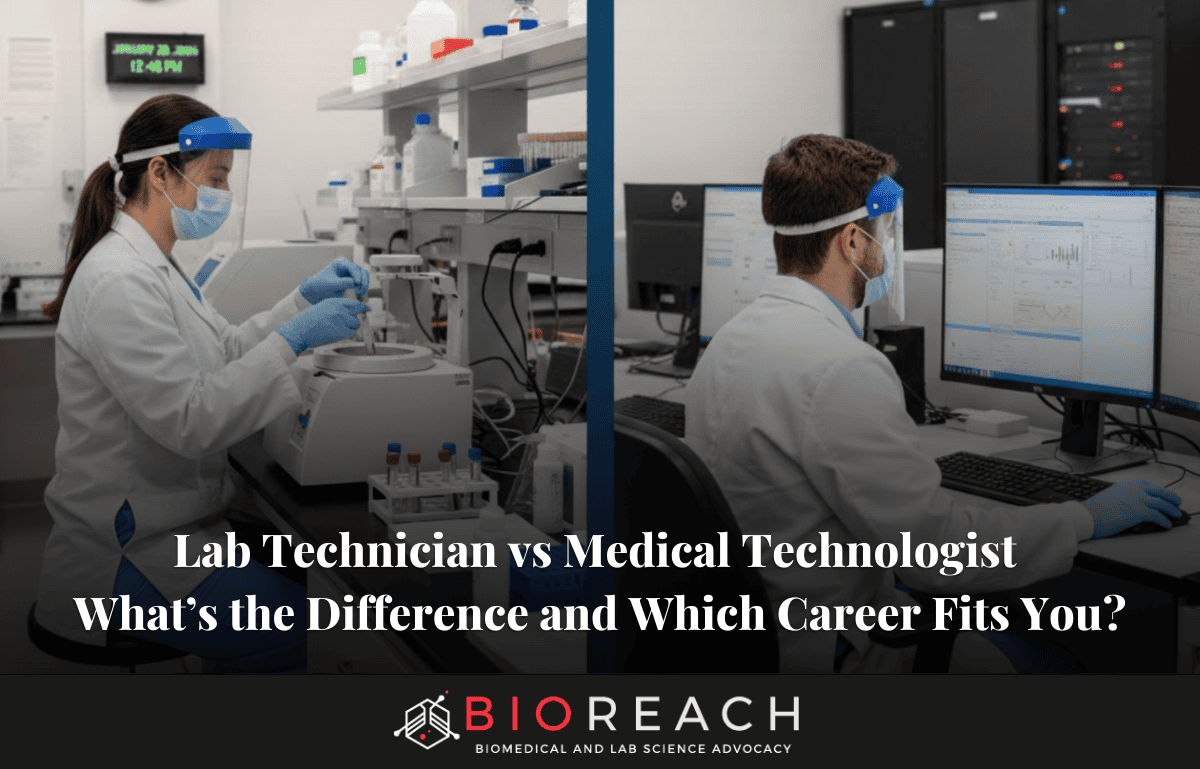
If you’re exploring healthcare careers, you’ve probably come across two similar-sounding roles: lab technician and medical technologist. At first glance, they might seem like the same job with different titles. But understanding the difference between a lab technician and a medical technologist is crucial for choosing the right educational path and building the career you want.
At Bio-Reach Inc., we work with students every day who are trying to navigate these choices. Our mission is to strengthen healthcare by supporting students entering clinical laboratory and allied health careers, especially those from underserved communities. Whether you’re drawn to hands-on technical work or advanced problem-solving in the lab, we’re here to help you find your fit.
In this guide, we’ll break down everything you need to know about lab technician vs medical technologist careers, including education requirements, daily responsibilities, salary expectations, and growth opportunities. By the end, you’ll have a clear picture of which path aligns with your goals.
Quick Overview: Lab Technician vs Medical Technologist
Let’s start with a side-by-side comparison to help you see the big picture.
| Factor | Lab Technician (MLT) | Medical Technologist (MLS) |
|---|---|---|
| Education | Associate degree (2 years) | Bachelor’s degree (4 years) |
| Certification | MLT (ASCP) or equivalent | MLS (ASCP) or equivalent |
| Job Duties | Perform routine tests, prepare specimens, operate equipment | Perform complex tests, troubleshoot, analyze results, supervise |
| Work Environment | Hospitals, clinics, reference labs | Hospitals, research labs, public health facilities |
| Salary Range | $35,000 to $55,000/year | $55,000 to $80,000+/year |
| Best For | Quick entry into healthcare, hands-on work | Advanced responsibility, leadership roles, specialization |
Both roles are essential to patient care. The main differences come down to education level, scope of practice, and career advancement opportunities.
What Does a Lab Technician Do?
A clinical laboratory technician (also called a medical laboratory technician or MLT) performs essential lab tests that help doctors diagnose and treat patients. If you’ve ever had blood work done at a hospital or clinic, a lab technician likely processed your sample.
Daily Tasks
Lab technicians handle routine laboratory procedures under the supervision of medical technologists or laboratory managers. Here’s what a lab technician does in a hospital on a typical day:
- Collect and prepare blood, tissue, and body fluid samples
- Perform routine tests in areas like hematology, chemistry, and microbiology
- Operate and maintain laboratory equipment
- Record test results accurately in computer systems
- Follow strict safety and quality control procedures
- Prepare specimens for more complex testing
Lab technicians work in a structured environment where procedures are well-defined. You’ll follow established protocols to ensure accurate, reliable results.
Work Environment
Lab technicians work in hospitals, outpatient clinics, diagnostic laboratories, blood banks, and physicians’ offices. The work is typically done in a controlled laboratory setting with proper safety equipment and protocols.
Most positions involve:
- Standing for extended periods
- Handling biological specimens safely
- Working with microscopes and automated analyzers
- Collaborating with other lab staff and healthcare providers
Some labs operate 24/7, so evening, weekend, or overnight shifts may be available or required depending on the facility.
Required Education
To become a lab technician, you need an associate degree in medical laboratory technology or clinical laboratory science. These programs typically take two years to complete and include both classroom learning and hands-on clinical training.
Your coursework will cover:
- Medical terminology
- Human anatomy and physiology
- Clinical chemistry
- Hematology (study of blood)
- Microbiology (study of microorganisms)
- Immunology
- Laboratory safety and quality assurance
Many community colleges and technical schools offer affordable MLT programs, making this an accessible entry point into healthcare careers.
Certifications
After completing your education, you can pursue certification through organizations like the American Society for Clinical Pathology (ASCP). The MLT (ASCP) credential demonstrates your competency and is often required or preferred by employers.
Certification requirements typically include:
- Graduation from an accredited MLT program
- Passing a comprehensive exam
- Maintaining continuing education credits
Skills Needed
Successful lab technicians have:
- Strong attention to detail
- Good hand-eye coordination
- Basic computer skills
- Ability to follow instructions precisely
- Good communication skills
- Patience and focus
Salary Expectations
Lab technician salaries vary by location, experience, and work setting. According to recent data, the average lab technician salary ranges from $35,000 to $55,000 per year. Entry-level positions typically start around $35,000 to $40,000, while experienced technicians in metropolitan areas can earn $50,000 or more.
What Does a Medical Technologist Do?
A medical technologist (also called a medical laboratory scientist or MLS) performs more advanced and complex laboratory testing. They have greater independence, analytical responsibility, and often supervise lab technicians.
Daily Responsibilities
Medical technologist responsibilities go beyond routine testing. These professionals:
- Perform complex diagnostic tests requiring advanced skills
- Analyze and interpret test results
- Troubleshoot equipment problems and unusual test results
- Validate new testing methods and procedures
- Ensure quality control and accuracy across all testing
- Supervise lab technicians and train new staff
- Communicate findings with physicians and healthcare teams
- Conduct research and implement new technologies
Medical technologists work with greater autonomy and are trusted to handle the most challenging specimens and situations.
Advanced Testing
Medical technologists are trained to work in all laboratory departments, including:
- Clinical chemistry (blood chemistry, hormone levels)
- Hematology (blood cell analysis, coagulation studies)
- Microbiology (identifying bacteria, viruses, parasites)
- Immunology and serology (immune system testing)
- Blood banking (transfusion medicine)
- Molecular diagnostics (genetic testing, DNA analysis)
They may specialize in one area or maintain proficiency across multiple disciplines.
Troubleshooting Duties
When test results don’t make sense or equipment malfunctions, medical technologists investigate. They use critical thinking to:
- Identify potential errors in testing
- Determine if results reflect actual patient conditions
- Recommend additional or alternative tests
- Consult with pathologists and physicians
This analytical work requires deep understanding of both the science and the clinical context.
Education Level
Education requirements for medical technologist positions include a bachelor’s degree in medical laboratory science, clinical laboratory science, or a related field. These programs take four years and include extensive clinical rotations in actual laboratories.
Your education will cover advanced topics in:
- Clinical biochemistry
- Advanced hematology and hemostasis
- Clinical microbiology and parasitology
- Immunohematology (blood banking)
- Molecular diagnostics
- Laboratory management and education
- Research methods
The additional education provides both broader knowledge and deeper expertise than an associate degree program.
Required Certification
Medical technologists typically earn the MLS (ASCP) certification or equivalent credentials from recognized certifying organizations. This certification demonstrates advanced competency and is required by most employers.
Requirements include:
- Bachelor’s degree from an accredited program
- Passing a comprehensive certification exam
- Ongoing continuing education
Salary Range
Medical technologists earn higher salaries than lab technicians, reflecting their advanced education and responsibilities. The typical salary range is $55,000 to $80,000+ per year. Experienced professionals in supervisory roles or specialized areas can earn $85,000 or more, especially in major metropolitan areas or research institutions.
Key Differences Between Lab Technician and Medical Technologist

Now that we’ve explored each role, let’s examine the responsibilities and requirements of the lab technician vs medical technologist more closely.
Role Complexity
Lab technicians perform routine, standardized tests following established procedures. Medical technologists handle complex testing that requires judgment, interpretation, and problem-solving. Think of it this way: technicians execute the tests, while technologists also analyze, validate, and troubleshoot.
Scope of Practice
The scope of practice for a lab technician vs medical technologist differs significantly:
Lab Technicians:
- Perform routine procedures under supervision
- Work from standard protocols
- Focus on accuracy and efficiency
- Report results to supervisors
Medical Technologists:
- Perform all testing, including complex and rare procedures
- Validate and interpret results
- Make decisions about testing procedures
- Supervise other laboratory personnel
- Participate in quality improvement and research
In many states, there are also legal distinctions in scope of practice, with certain tests or procedures reserved for medical technologists.
Education
The education gap is one of the clearest differences:
- Lab Technician: Associate degree (2 years)
- Medical Technologist: Bachelor’s degree (4 years)
The additional education for medical technologists includes more in-depth science courses, advanced laboratory techniques, and management training.
Certification
Both roles have professional certifications, but they’re at different levels:
- Lab Technician: MLT (ASCP) or equivalent
- Medical Technologist: MLS (ASCP) or equivalent
The certification exams reflect the different knowledge levels and responsibilities of each position.
Salary
The pay scale difference between lab tech and med tech is substantial. Medical technologists typically earn $15,000 to $25,000 more per year than lab technicians, though this varies by region and experience.
This salary difference reflects the additional education, greater responsibility, and higher skill level required for medical technologist positions.
Growth Opportunities
Career advancement looks different for each path:
Lab Technicians can:
- Gain experience and increase pay within their role
- Specialize in specific testing areas
- Move into senior technician positions
- Return to school to become medical technologists
Medical Technologists can:
- Become laboratory supervisors or managers
- Specialize in areas like blood banking or molecular diagnostics
- Move into quality assurance or compliance roles
- Pursue advanced degrees for research or teaching
- Become laboratory directors (often requires additional credentials)
Leadership Potential
Is a medical technologist higher than a lab technician? In terms of hierarchy, yes. Medical technologists often supervise lab technicians and have greater decision-making authority. They’re more likely to advance into management and leadership positions within the laboratory.
Career Growth: Which Path Is Better for You?

There’s no single answer to which is better lab technician or a medical technologist. The right choice depends on your personal circumstances, goals, and preferences.
Consider Lab Technician If You:
- Want to enter the workforce quickly (2 years vs. 4 years)
- Prefer structured, routine work with clear procedures
- Need a more affordable education pathway
- Enjoy hands-on technical work
- Value work-life balance with less supervisory pressure
- Plan to gain experience before deciding on further education
The lab technician path offers faster career entry and can be an excellent stepping stone. Many successful medical technologists started as lab technicians.
Consider a Medical Technologist If You:
- Want greater responsibility and autonomy
- Enjoy complex problem-solving and critical thinking
- Are interested in specialization or research
- Have a strong interest in advancing to leadership roles
- Can commit to four years of education
- Seek a higher earning potential
The medical technologist path requires more upfront investment in education but offers greater long-term career options and earning potential.
Learning Preferences
Think about how you learn best. Lab technician programs are more focused and practical, getting you into the workforce quickly. Medical technologist programs are more comprehensive and theoretical, preparing you for a wider range of roles.
Education Goals
Consider your current situation. If you need to start earning sooner or have financial constraints, the two-year associate degree might be more feasible. If you can invest in four years of education, you’ll have more career flexibility later.
Many students start as lab technicians and later complete a bachelor’s degree while working. This “bridge program” approach offers the best of both worlds, though it takes longer overall.
Long-Term Vision
Where do you see yourself in 10 or 20 years? If you envision yourself in laboratory leadership, research, or specialized testing, the medical technologist path provides a stronger foundation. If you prefer consistent, hands-on technical work without management pressure, a lab technician career can be deeply fulfilling.
Lab Technician vs Medical Technologist Career Growth
Both careers offer stability and steady demand. The Bureau of Labor Statistics projects growth for both clinical laboratory technicians and medical technologists as healthcare expands and the population ages. However, medical technologists may have more opportunities for advancement and specialization.
Salary Comparison: Lab Tech vs Med Tech
Let’s look more closely at the lab technician vs medical technologist salary differences across career stages.
Entry-Level Positions
Lab Technicians typically start at $35,000 to $42,000 per year, depending on location and facility type.
Medical Technologists generally begin at $52,000 to $60,000 per year, reflecting their bachelor’s degree and broader training.
Mid-Career Salaries
With 5 to 10 years of experience:
Lab Technicians earn $42,000 to $52,000, with increases coming from experience, additional certifications, or shift differentials.
Medical Technologists earn $60,000 to $72,000, with opportunities for higher pay through specialization or supervisory duties.
Experienced Professional Salaries
After 10+ years:
Lab Technicians may reach $48,000 to $58,000 in senior or specialized roles.
Medical Technologists can earn $70,000 to $85,000+, especially in supervisory, specialist, or management positions.
Geographic Variation
Salaries vary significantly by region. Metropolitan areas and states with higher costs of living typically pay more. For example, medical technologists in California, New York, or Massachusetts often earn $75,000 to $95,000, while those in rural or lower-cost areas may earn $55,000 to $70,000.
Factors Affecting Salary
Both lab tech vs med tech salaries are influenced by:
- Years of experience
- Geographic location
- Type of facility (hospital, reference lab, clinic)
- Shift schedules (night and weekend shifts often pay more)
- Additional certifications or specializations
- Supervisory or management responsibilities
The bottom line: medical technologists consistently earn more throughout their careers, but lab technicians can achieve comfortable salaries with less educational investment.
Scope of Practice: What You Can and Cannot Do

Understanding the legal and practical scope of practice for lab technician vs medical technologist is important for career planning and daily work.
Lab Technician Scope
Lab technicians work under the supervision of medical technologists, pathologists, or laboratory managers. Their scope typically includes:
What Lab Technicians Can Do:
- Perform routine tests in all laboratory departments
- Operate standard laboratory equipment
- Prepare and process specimens
- Record and report test results
- Maintain quality control procedures
- Assist with basic troubleshooting
What Lab Technicians May Not Do:
- Perform highly complex or rare testing without supervision
- Validate new testing methods independently
- Authorize release of critical results without review
- Supervise medical technologists
- Make final determinations on unusual specimens
The specific limitations vary by state regulations, facility policies, and CLIA (Clinical Laboratory Improvement Amendments) complexity categories.
Medical Technologist Scope
Medical technologists have broader authority and independence:
What Medical Technologists Can Do:
- Perform all levels of testing, from routine to highly complex
- Analyze and interpret results independently
- Troubleshoot problems and investigate discrepancies
- Validate new equipment and procedures
- Supervise laboratory technicians and other staff
- Authorize release of test results
- Participate in research and development
- Train and evaluate personnel
Limitations:
- Must work within state and federal regulations
- Cannot diagnose conditions (that’s the physician’s role)
- Must consult with pathologists on unusual or critical findings
The greater scope of practice means medical technologists have more decision-making authority and professional independence.
Regulatory Considerations
Both roles are governed by:
- CLIA regulations (federal laboratory standards)
- State licensing requirements (varies by state)
- Facility policies and procedures
- Professional certification standards
Some states require licensure for both lab technicians and medical technologists, while others only require certification. It’s important to check your state’s specific requirements.
Career Implications
The different scopes of practice directly impact your daily work experience. Lab technicians work with more structure and oversight, which can be reassuring when you’re starting out. Medical technologists have more autonomy and responsibility, which can be exciting or stressful depending on your personality.
How Bio-Reach Helps You Enter These Careers
Choosing between lab technician and medical technologist is just the first step. Actually entering these careers requires guidance, experience, and support, especially if you’re coming from an underserved community or don’t have connections in healthcare.
That’s where Bio-Reach Inc. comes in.
Our Mission
Bio-Reach exists to strengthen healthcare by supporting students entering clinical laboratory and allied health careers. We believe everyone deserves access to meaningful work that serves their community, regardless of their background or circumstances.
We focus on:
- Providing equitable access to healthcare career opportunities
- Offering early exposure to clinical laboratory work
- Connecting students with mentors and professionals
- Building skills through real-world training
- Developing the next generation of laboratory workforce
Career Shadowing and Mentorship
Through our Career Shadowing and Mentorship program, you can spend time in actual clinical laboratories, observing both lab technicians and medical technologists at work. This experience is invaluable for understanding the lab technician vs medical technologist work environment and making an informed decision.
You’ll see:
- What a typical day looks like in each role
- How teams work together in the lab
- The types of technology and equipment used
- The pace and atmosphere of different lab settings
Our mentors can also answer your questions, share their career paths, and provide guidance on education and certification.
Pathway Phlebotomy Training
Many students enter laboratory careers through phlebotomy, the practice of drawing blood. Our Pathway Phlebotomy Training program provides hands-on skills training and certification preparation. Phlebotomy is an excellent entry point that can lead to lab technician or medical technologist positions as you continue your education.
LabLit: Public Awareness and Guidance
Our LabLit initiative provides educational resources, career information, and guidance for students exploring laboratory careers. We help you understand:
- Different career paths in clinical laboratories
- Education and certification requirements
- How to choose the right program
- Financial aid and scholarship opportunities
- What employers are looking for
LabConnect: Community Development
Through LabConnect, we build communities of students, professionals, and educators who support each other’s growth. You’ll have access to networking opportunities, professional development, and ongoing encouragement as you pursue your goals.
LabAid: Global Lab Support
Our LabAid program connects students with global health initiatives, showing how laboratory work impacts communities worldwide. This broader perspective helps you understand the vital role laboratory professionals play in healthcare systems everywhere.
Support for Underserved Communities
Bio-Reach is especially committed to supporting students from underserved communities who face barriers to entering healthcare careers. We provide:
- Guidance through the application process
- Connection to scholarship and financial aid resources
- Support navigating prerequisites and program requirements
- Help building professional networks
- Encouragement and advocacy throughout your journey
Whether you choose to become a lab technician or medical technologist, Bio-Reach is here to help you succeed.
Conclusion
The choice between lab technician vs medical technologist depends on your education goals, career aspirations, and personal circumstances. Both are rewarding careers that contribute directly to patient care and public health.
Lab technicians offer a faster path into the workforce with an associate degree, performing essential hands-on testing in hospitals and clinics. If you want to start working sooner and prefer structured, routine work, this path might be ideal.
Medical technologists require a bachelor’s degree but provide greater responsibility, higher salaries, and more advancement opportunities. If you’re drawn to complex problem-solving and leadership, this investment pays off over time.
Remember these key differences:
- Lab technicians need two years of education; medical technologists need four
- Medical technologists earn significantly more throughout their careers
- Medical technologists have broader scope of practice and more autonomy
- Lab technicians can bridge to medical technologist with additional education
- Both careers offer stability and growing demand
The difference between lab technician and medical technologist ultimately comes down to the level of education, complexity of work, and career trajectory. Neither choice is better or worse; they simply serve different goals and preferences.
If you’re ready to explore these careers further, Bio-Reach Inc. is here to guide you. Whether you need mentorship, shadowing opportunities, skills training, or just someone to answer your questions, we’re committed to helping you find your place in healthcare.
Laboratory professionals are the unsung heroes of medicine, providing the test results that guide 70% of medical decisions. Whether you become a lab technician or medical technologist, you’ll be part of a vital profession that saves lives every day.
Take the first step today. Explore your options, connect with professionals in the field, and imagine yourself making a difference in healthcare. Whatever path you choose, the laboratory community welcomes you.
Ready to learn more about clinical laboratory careers? Visit Bio-Reach Inc. to explore our programs, connect with mentors, and start your journey into healthcare. We’re here to support you every step of the way.