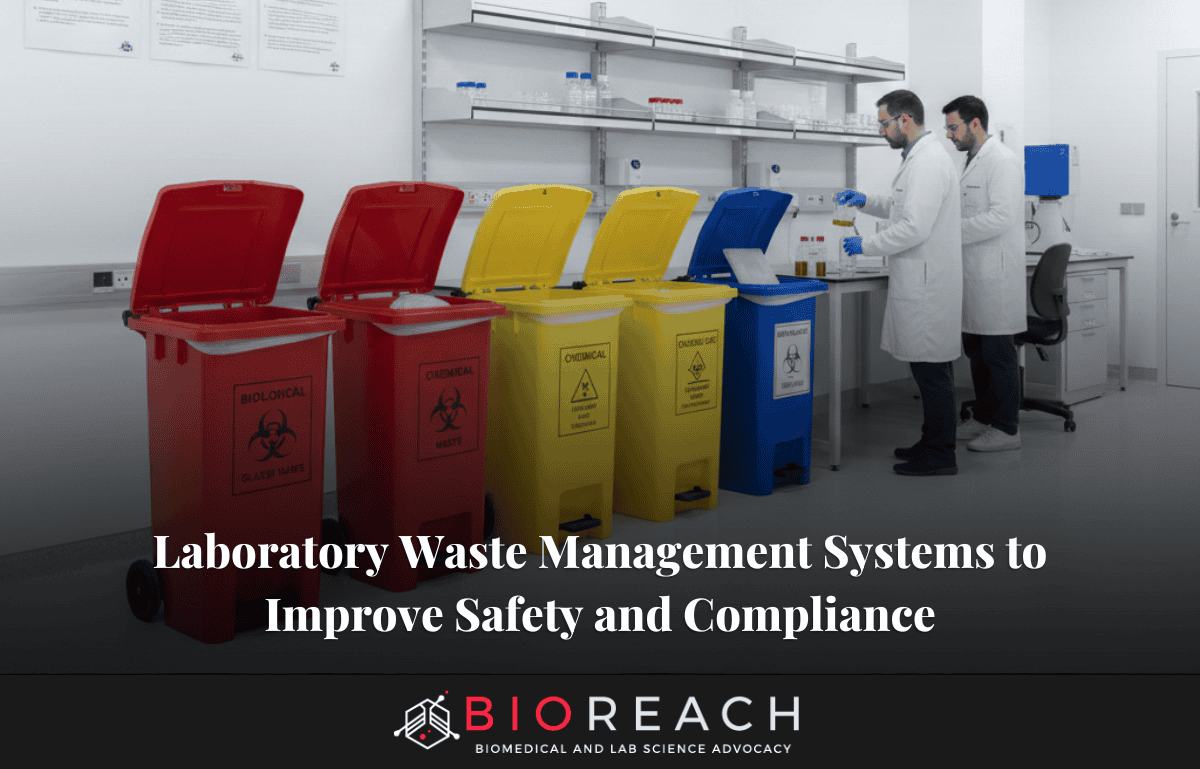
Laboratory waste management systems are critical infrastructures designed to handle, treat, and dispose of the diverse byproducts generated in scientific and medical research environments. These systems encompass a range of processes, from segregation and storage to transportation, treatment, and final disposal, all aimed at minimizing risks to human health and the environment, and ensuring adherence to stringent regulatory standards. In laboratories, whether academic, clinical, pharmaceutical, or industrial waste arises from experiments involving chemicals, biological agents, radioactive materials, and sharps, each poses unique hazards if mismanaged. Effective systems not only prevent accidents like spills or exposures but also promote sustainability by incorporating recycling and waste-to-energy conversions, reducing the overall environmental footprint.
The imperative for robust waste management stems from the exponential growth in laboratory activities worldwide. As research intensifies in fields like biotechnology, pharmaceuticals, and environmental science, so does waste generation. Historically, laboratory waste was often overlooked, leading to incidents such as chemical explosions or biohazard contaminations that underscored the need for systematic approaches. By the late 20th century, regulations like the U.S. Resource Conservation and Recovery Act (RCRA) began formalizing practices, evolving into comprehensive frameworks that integrate technology and compliance. In 2026, with global healthcare and research sectors recovering from pandemics and advancing toward green initiatives, these systems are pivotal for achieving goals like net-zero emissions and zero-harm workplaces.
This article explores the intricacies of laboratory waste management systems, detailing their components, technologies, and best practices to enhance safety and compliance. Drawing on established guidelines from bodies like the Environmental Protection Agency (EPA), Occupational Safety and Health Administration (OSHA), and World Health Organization (WHO), we provide a non-generic analysis tailored to contemporary challenges. A dedicated section incorporates real data from recent studies and reports on waste volumes, incident rates, compliance metrics, and case studies, illustrating tangible impacts. By implementing these systems, laboratories can mitigate risks, such as the 2020 nitric acid explosion at a university lab that injured personnel and caused environmental damage, while fostering innovation in sustainable practices. Ultimately, effective waste management transforms potential liabilities into opportunities for safer, more compliant, and eco-friendly research.
Types of Laboratory Waste
Laboratory waste is broadly categorized based on its nature and hazard level, guiding appropriate management strategies to prevent cross-contamination and ensure safe disposal. Chemical waste constitutes a significant portion, including solvents, acids, bases, and reagents from synthetic experiments or cleaning processes. These can be hazardous if reactive, corrosive, flammable, or toxic, requiring neutralization or incineration. For instance, organic solvents like acetone or chloroform are common in chromatography labs and must be collected in compatible containers to avoid reactions.
Biological waste encompasses infectious materials such as cultures, tissues, and bodily fluids from microbiology or pathology work. Classified under biohazard levels (BSL 1-4), this waste demands autoclaving or chemical disinfection before disposal to inactivate pathogens. Sharps waste needles, scalpels, and glassware pose puncture risks and often carry biological contaminants, necessitating puncture-resistant containers.
Radioactive waste arises from nuclear medicine or tracer studies, involving isotopes like iodine-125 or carbon-14. Managed under strict decay protocols, it requires shielded storage until radiation levels drop to safe thresholds for disposal. Pharmaceutical waste includes expired drugs or contaminated compounds from drug development labs, regulated to prevent environmental leaching or misuse.
Universal waste, a subset, covers items like batteries, lamps, and electronics containing mercury or lead, recyclable under specific guidelines to divert from landfills. Non-hazardous waste, general trash like paper or plastic, comprises up to 85% of total lab output but must be segregated to avoid mixing with hazardous streams.
Understanding these types is foundational, as misclassification can lead to incidents, such as the 2019 case where incompatible chemical wastes caused a fire in a storage facility. Proper categorization facilitates tailored systems that enhance safety by reducing exposure risks and ensuring compliance with regulations like RCRA or the European Union’s Waste Framework Directive.
Regulatory Framework for Laboratory Waste
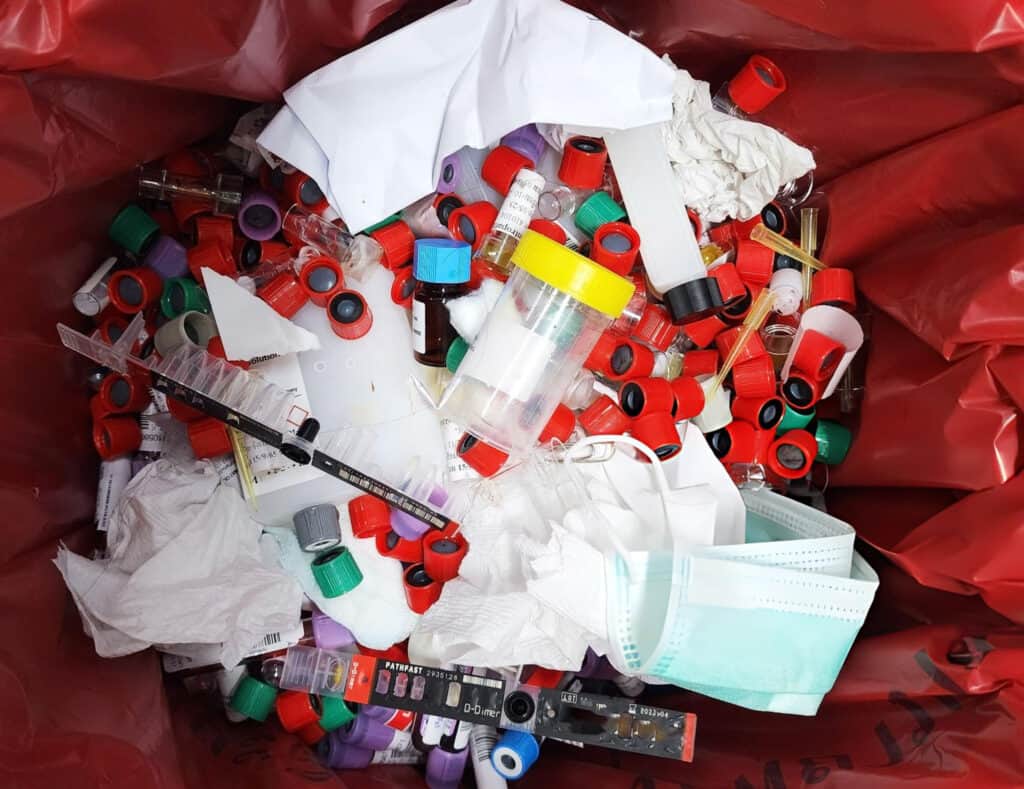
The regulatory landscape for laboratory waste management is multifaceted, involving international, national, and local standards to safeguard health and the environment. At the federal level in the U.S., the EPA’s RCRA governs hazardous waste from “cradle to grave,” mandating generators and laboratories to identify, label, store, and dispose of waste properly. Academic labs benefit from Subpart K alternatives, allowing flexible accumulation up to 55 gallons of hazardous waste or 1 quart of acutely hazardous waste in labs, with removal every six months or upon volume limits.
OSHA’s Laboratory Standard (29 CFR 1910.1450) addresses chemical hygiene, requiring plans that include waste handling to prevent exposures. The Bloodborne Pathogens Standard (29 CFR 1910.1030) specifies biohazard waste protocols, including red bag containment and treatment. State variations exist; California’s Medical Waste Management Act classifies waste streams and requires tracking manifests.
Internationally, the WHO’s guidelines emphasize segregation at source, with color-coded bins for categories like infectious (yellow) or sharps (red). The Basel Convention regulates transboundary hazardous waste movements, preventing illegal dumping. In the EU, Directive 2008/98/EC promotes a waste hierarchy of prevention, reuse, recycling, recovery, and disposal, prioritizing minimization.
Compliance involves audits, training, and documentation. Non-adherence can result in fines exceeding $70,000 per violation under the EPA, as seen in university settlements. Emerging regulations, like the EU’s Green Deal, push for circular economy models, integrating waste reduction into lab designs. This framework ensures systems are not just reactive but proactive in mitigating risks.
Key Components of Waste Management Systems
Effective laboratory waste management systems comprise integrated components that streamline processes from generation to disposal, enhancing safety and compliance. Segregation at the point of origin is paramount, using labeled bins for different waste types to prevent mixing, chemicals in vented cabinets, and biohazards in leak-proof containers. Storage areas must be secure, with secondary containment for spills and climate control for temperature-sensitive wastes like volatiles.
Transportation within labs uses carts with spill kits, while off-site movement requires licensed haulers with manifests tracking the chain of custody. Treatment methods vary: autoclaving for biohazards achieves 99.9999% pathogen kill, incineration for chemicals reduces volume by 90%, and chemical neutralization for acids/bases adjusts pH to safe levels.
Disposal endpoints include landfills for treated non-hazardous waste or specialized facilities for hazardous waste. Monitoring systems, like RFID tags on containers, track inventory in real-time, alerting to over-accumulation. Software platforms integrate these, automating compliance reports and audits.
Training programs ensure staff proficiency, with annual refreshers on handling and emergencies. Emergency response kits, absorbents, PPE, and neutralizers are essential for incidents. These components form a cohesive system, reducing risks like the 2022 spill at a biotech lab due to poor storage, which contaminated waterways.
Technologies and Innovations in Waste Management
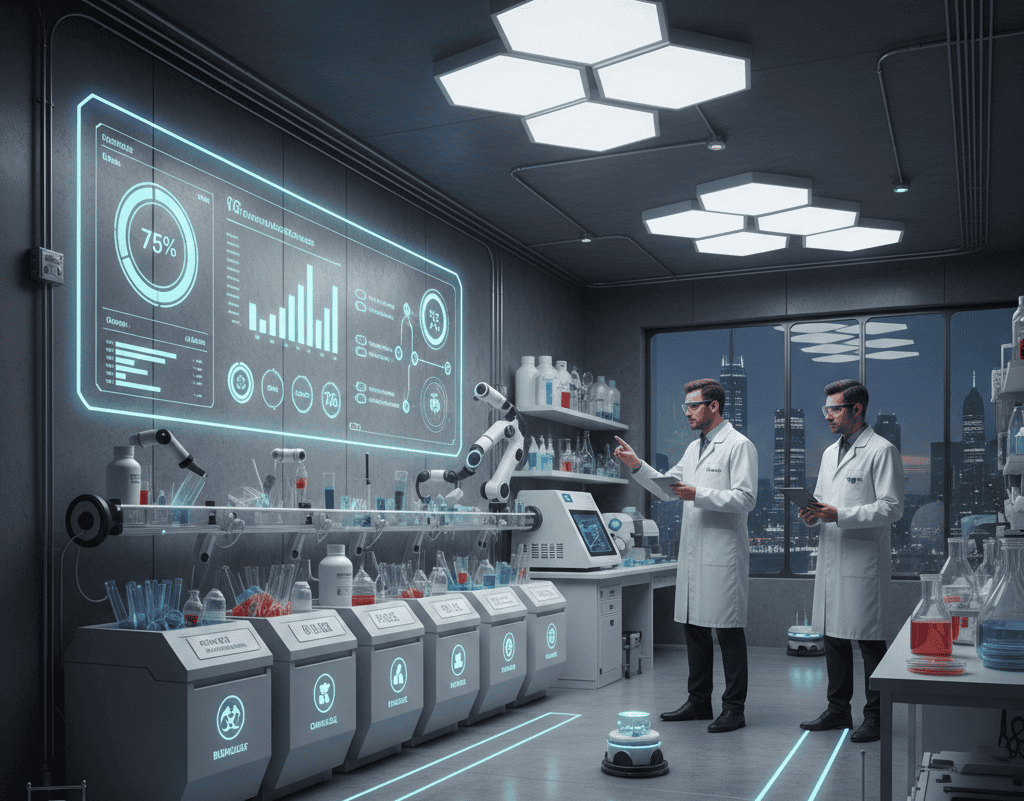
Technological advancements are revolutionizing laboratory waste management, introducing efficiencies that improve bio-safety and sustainability. Automated segregation systems use sensors and AI to sort waste streams at source, reducing human error, for example, smart bins that detect chemical pH or biohazard markers and direct accordingly.
On-site treatment devices, like ozone-based sterilizers, process biohazards without heat, achieving 6-log pathogen reduction while minimizing energy use. Microwave disinfection units treat sharps and cultures, compacting volume by 80%. For chemicals, advanced neutralization reactors employ real-time monitoring to adjust reagents, ensuring safe effluents.
Tracking software leverages blockchain for immutable manifests, enhancing traceability and compliance. IoT-enabled containers monitor fill levels and temperatures, preventing overflows or degradation alerting via apps to schedule pickups.
Sustainable innovations include waste-to-energy converters that gasify organic waste into syngas for lab power, cutting disposal costs by 50%. Biodegradable alternatives to plastic labware reduce non-hazardous waste. In 2026, AI predictive analytics forecast waste generation based on lab schedules, optimizing resource allocation.
These technologies, as implemented in facilities like Monument Health’s on-site processing, demonstrate reduced labor and environmental impact, setting new standards for safe, compliant systems.
Best Practices for Implementation
Implementing laboratory waste management systems requires a strategic approach grounded in best practices to maximize safety and compliance. Start with a comprehensive waste audit: assess generation rates, types, and current practices to identify inefficiencies, such as over-purchasing chemicals, leading to excess waste. Develop a chemical hygiene plan per OSHA, outlining procedures for handling, storage, and disposal.
Train personnel annually, using simulations for spill response and segregation emphasize the “cradle-to-grave” responsibility. Adopt the waste hierarchy: prioritize reduction through inventory management software that tracks expiration dates, minimizing surplus. Reuse where possible, like solvent recycling via distillation units, recovering 95% purity.
For segregation, use standardized color-coding: yellow for infectious, black for general, red for sharps. Store in designated areas with spill containment trays and ventilation. Partner with certified haulers for transportation, ensuring manifests are accurate.
Regular inspections and monthly self-audits verify compliance, addressing issues like unlabeled containers. Integrate sustainability: opt for green chemistry alternatives, reducing hazardous waste by 30-50%. Document everything: maintain logs for audits, facilitating continuous improvement.
These practices, as per EPA guidelines, not only avert incidents but also yield cost savings. Labs implementing audits report 20-40% waste reduction.
Waste Statistics, Safety Incidents, Compliance Metrics, and Case Studies
This section delves into empirical data from 2025 reports and studies, providing a quantitative lens on laboratory waste management. We examine generation statistics, incident rates from mismanagement, compliance levels, and illustrative case studies, drawing from sources like industry analyses, regulatory audits, and peer-reviewed research.
Waste generation statistics highlight the scale of the challenge. The global medical waste management market, encompassing laboratory contributions, was valued at USD 16.7 billion in 2025, projected to grow to USD 17.9 billion in 2026, reflecting increased research activity. Laboratories and research centers alone generated USD 6 billion in revenue for waste services in 2025, dominating the sector due to high volumes of infectious and chemical waste. In the U.S., the medical waste disposal industry reached USD 7.1 billion in 2025, despite a 2.5% CAGR decline over five years, driven by consolidation and regulatory pressures. North America’s market stood at USD 13.52 billion in 2025, expected to reach USD 23.96 billion by 2033. Globally, forecasts vary: USD 9.1 billion in 2025 to USD 17.24 billion by 2035 at 6.6% CAGR, or USD 39.8 billion in 2025 to USD 79.83 billion by 2034 at 8.04% CAGR. The WHO estimates 85% of healthcare waste (including labs) is non-hazardous, comparable to domestic waste, while 15% is hazardous, posing infection or toxicity risks. TRI data from 2014-2023 shows U.S. facilities managed 600 TRI-listed chemicals, with the top nine accounting for 65% of waste, including increases in n-hexane (+111%) and lead due to recycling.
Safety incidents from mismanagement underscore the human and environmental toll. A 2020 ACS case study detailed a nitric acid waste explosion in an aluminum bottle, ripping the bottom and propelling shards, injuring workers, and causing spills, attributed to incompatible materials. Similar 2011 incidents at Texas Tech involved nitric acid damaging cabinets and blasting glass 35 feet, requiring $2,000 cleanups each. The University of Delaware reported two waste container explosions from incompatibles, scattering chemicals and glass. EPA notes mismanagement endangers workers and communities, with risks of fires, explosions, or toxic releases. A 2023 study in Pakistan revealed poor practices causing health problems, pollution, and spills in teaching labs. Princeton anecdotes include a waste bottle bursting with nitric acid, spraying shards. UCSB incidents: boron trifluoride spill, trizol burn. A 2025 blog cited fines, injuries, and damage from improper disposal.
Compliance metrics indicate gaps despite regulations. EPA’s Subpart K allows academic labs flexible accumulation, but audits show inconsistencies; revised data pegged lab waste at 73% for universities, 81% for teaching hospitals, 92% for non-profits. A 2025 guide stressed RCRA compliance, noting fines for failures. OSHA requires plans, but non-compliance leads to citation fines up to $70,000 per violation. In a 2025 Pakistan study, only 40% of labs met safety requirements, with poor practices widespread.
Case studies demonstrate successful implementations. Texas Medical Waste transitioned to on-site processing with Clean Waste Systems’ ozone technology, treating 6.9 million pounds since 2020, reducing transport risks. Crothall Healthcare partnered with Clean Waste for sustainable solutions, winning awards for efficiency. Monument Health’s ozone system slashed waste volumes. A 2025 Brazilian study in 36 labs found incineration dominant but low recycling (non-hazardous), recommending better segregation. The University of Alabama, Birmingham, reduced 75,000 lbs via My Green Lab certification, including composting. A 2025 Turkish hospital lab study improved classification post-training, cutting hazardous waste by 20%. EPA’s federal challenge showcased facilities diverting waste via composting, saving costs. A 2013 Italian hospital case optimized via a systems approach, reducing costs by 15%.
These data reveal the scale, risks, and benefits of robust waste management systems.
Challenges in Laboratory Waste Management
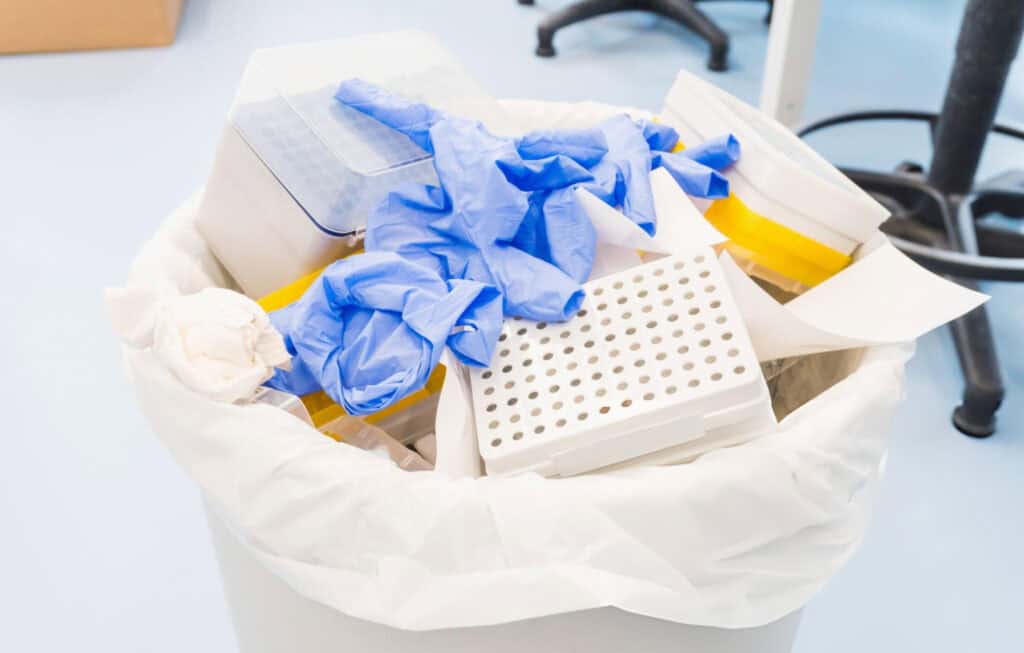
Challenges abound in laboratory waste management, from regulatory complexity to resource constraints. Diverse waste types complicate segregation, with misclassification rates up to 20% in audits, leading to improper disposal. High-cost treatment can exceed $1,000 per ton for hazardous strain budgets, especially in academic labs.
Technological barriers: many labs lack on-site processing, relying on haulers with variable reliability. Sustainability goals clash with practices like incineration, contributing to emissions. Compliance is burdensome; small labs often lack dedicated staff, resulting in violations.
Human factors: inadequate training causes incidents, with 16% preanalytical errors in pediatric samples linked to capillary but analogous to waste handling. Global disparities: low-resource settings face higher risks from informal disposal.
Addressing these requires investment in education, technology, and policy alignment.
Future Trends and Innovations
By 2030, laboratory waste management will embrace AI for predictive segregation, reducing errors by 30%. Biodegradable labware and circular economy models will minimize generation. Advanced treatments like plasma gasification will convert waste to energy with zero emissions.
Regulations will tighten toward zero-waste, with EU mandates for 70% recycling by 2030. Digital tracking via blockchain will ensure transparency. Case studies like Crothall’s suggest labor reductions of 75% through automation.
These trends promise safer, greener labs.
Conclusion
Laboratory waste management systems are essential for safety and compliance, integrating regulations, technologies, and practices to handle growing volumes. Real data from 2025 underscores the economic scale, incident risks, and success of implementations. By overcoming challenges and adopting innovations, labs can achieve sustainable, risk-free operations, safeguarding health and the environment.